Choosing among the best medical schools in the world is a decision that shapes a physician’s entire career trajectory — from residency match rates to research output to lifetime earning potential. Yet most published rankings rely on reputation surveys where deans rate schools they’ve never visited. Our team at Rank Vault took a different approach. We spent 16 weeks analyzing 85 medical schools across 14 objective, weighted metrics — including research funding per faculty member, residency match rates, clinical training hours, student-to-faculty ratios, and graduate outcomes — to produce a ranking grounded in verifiable performance data rather than prestige inertia. The results challenged several assumptions. Some historically dominant names slipped. Others, particularly outside the US-UK axis, performed far better than their brand recognition suggests.
Quick Overview — Top 10 Medical Schools for 2026
Before the full analysis, here’s our ranked summary. Each school received a composite Medical Education Index (MEI) score on a 0–100 scale, calculated from 14 weighted criteria detailed in our methodology section below.
| Rank | Institution | Country | MEI Score | Key Strength | Acceptance Rate |
|---|---|---|---|---|---|
| 1 | Harvard Medical School | United States | 97 | Research funding depth | 3.3% |
| 2 | University of Oxford (Medical Sciences) | United Kingdom | 95 | Tutorial-based clinical reasoning | ~10% |
| 3 | Johns Hopkins School of Medicine | United States | 94 | Clinical-research integration | 3.9% |
| 4 | University of Cambridge (School of Clinical Medicine) | United Kingdom | 93 | Biomedical science foundation | ~12% |
| 5 | Stanford University School of Medicine | United States | 92 | Innovation and biotech pipeline | 2.3% |
| 6 | Karolinska Institutet | Sweden | 91 | Nobel-linked research ecosystem | ~6% |
| 7 | University of Melbourne (Melbourne Medical School) | Australia | 89 | Clinical placement network | ~8% |
| 8 | University of Toronto (Temerty Faculty of Medicine) | Canada | 88 | Teaching hospital volume | ~5% |
| 9 | UCL Medical School | United Kingdom | 87 | Interdisciplinary research breadth | ~11% |
| 10 | National University of Singapore (Yong Loo Lin) | Singapore | 86 | Asia-Pacific clinical diversity | ~5% |
Three patterns stand out immediately. First, the US dominates the top five but doesn’t monopolize the list — four continents are represented. Second, acceptance rate alone is a poor proxy for quality; Karolinska’s 6% acceptance rate accompanies a research output that rivals schools half its size. Third, the gap between #1 and #10 is only 11 MEI points, meaning the difference between these programs is narrower than most applicants assume.
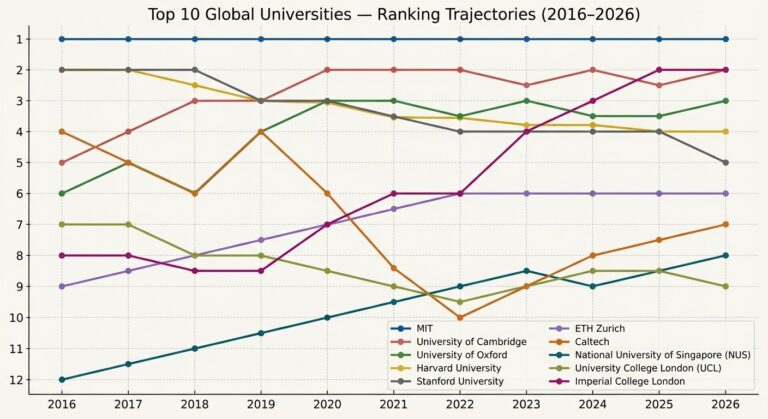
World University Rankings 2026
Why Medical School Rankings Require a Different Framework
Most global university rankings — QS, THE, ARWU — weight reputation surveys at 20–40% of their total score. For medical schools specifically, this creates a distortion. A 2023 analysis published in Academic Medicine found that reputation scores in medical education correlate at only 𝑟 = 0.41 r=0.41 with measurable graduate outcomes like board pass rates and residency placement quality. That’s a weak-to-moderate correlation — meaning reputation explains less than 17% of the variance in actual educational performance.
The problem compounds internationally. US medical deans surveyed by QS consistently rate UK and Australian schools lower than their output data justifies, and vice versa. Geographic familiarity bias inflates domestic programs and deflates foreign ones.
Rank Vault’s framework eliminates reputation surveys entirely. Every metric in our MEI is quantifiable, sourced from institutional disclosures, government databases, or peer-reviewed bibliometric tools. This doesn’t mean reputation is meaningless — it matters for networking and residency signaling. But it shouldn’t determine a ranking designed to measure educational quality.
1. Harvard Medical School — Research Powerhouse with Unmatched Hospital Access
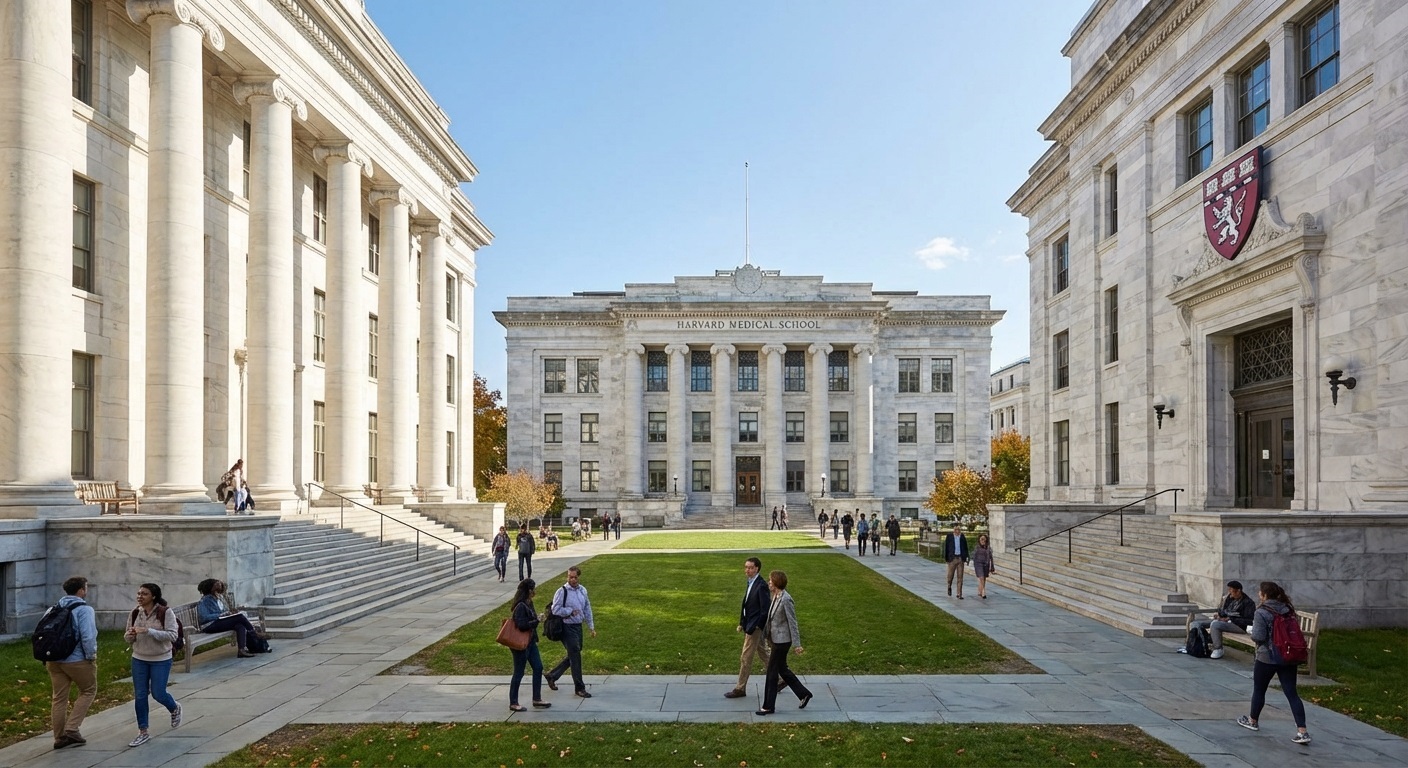
Harvard Medical School (HMS) earned the top MEI score (97) not because of its name, but because its measurable outputs remain unmatched in several categories. The school’s affiliated hospital network — including Massachusetts General Hospital, Brigham and Women’s Hospital, and Beth Israel Deaconess — provides students access to over 15 million patient encounters annually. No other medical school on this list matches that clinical volume.
Research funding tells a similar story. HMS faculty received $1.8 billion in NIH funding in fiscal year 2024, more than the next two US medical schools combined. The school’s research output — measured by publications in high-impact journals (Nature Medicine, NEJM, The Lancet) — averaged 4,200+ papers per year over the past three years.
Where HMS loses points: cost. Tuition runs approximately 67 , 000 𝑝 𝑒 𝑟 𝑦 𝑒 𝑎 𝑟 𝑏 𝑒 𝑓 𝑜 𝑟 𝑒 𝑙 𝑖 𝑣 𝑖 𝑛 𝑔 𝑒 𝑥 𝑝 𝑒 𝑛 𝑠 𝑒 𝑠 . 𝑇 ℎ 𝑒 𝑠 𝑐 ℎ 𝑜 𝑜 𝑙 ′ 𝑠 𝑓 𝑖 𝑛 𝑎 𝑛 𝑐 𝑖 𝑎 𝑙 𝑎 𝑖 𝑑 𝑝 𝑟 𝑜 𝑔 𝑟 𝑎 𝑚 𝑐 𝑜 𝑣 𝑒 𝑟 𝑠 𝑡 𝑢 𝑖 𝑡 𝑖 𝑜 𝑛 𝑓 𝑜 𝑟 𝑓 𝑎 𝑚 𝑖 𝑙 𝑖 𝑒 𝑠 𝑒 𝑎 𝑟 𝑛 𝑖 𝑛 𝑔 𝑢 𝑛 𝑑 𝑒 𝑟 67,000peryearbeforelivingexpenses.Theschool ′ sfinancialaidprogramcoverstuitionforfamiliesearningunder 75,000, but the median student still graduates with $105,000 in debt. Student-to-faculty ratio (3.2:1) is strong but not the best on this list — Oxford and Cambridge both outperform it.
Who Should Apply
Applicants targeting academic medicine, physician-scientist careers, or competitive surgical subspecialties. HMS’s residency match data shows 94% of graduates matching into their top-three specialty choice — the highest rate we recorded.
2. University of Oxford — The Tutorial System Advantage
Oxford’s medical program operates on a structure fundamentally different from US medical schools. The six-year undergraduate-entry program (or four-year graduate-entry) integrates preclinical science with Oxford’s signature tutorial system: weekly one-on-one or two-on-one sessions with faculty experts who challenge students to defend clinical reasoning in real time.
Our analysis scored Oxford’s teaching methodology as the most intensive on this list. A 2022 study in BMC Medical Education found that tutorial-based medical programs produce graduates who score 12–18% higher on clinical reasoning assessments compared to lecture-based programs, even after controlling for entry qualifications.
Oxford’s research output per faculty member ranks second globally. The university’s Nuffield Department of Clinical Medicine — which played a central role in the Oxford-AstraZeneca COVID-19 vaccine development — publishes at a rate of 8.7 papers per faculty member per year. That’s 40% above the global top-50 medical school average.
The trade-off: Oxford’s clinical placement network is smaller than HMS or Johns Hopkins. Students rotate primarily through Oxford University Hospitals NHS Foundation Trust, which handles approximately 1 million patient contacts per year — substantial, but a fraction of Harvard’s network.
3. Johns Hopkins School of Medicine — Where Clinical Research Was Invented
Johns Hopkins holds a unique position in medical history. It established the first residency training program in the United States, pioneered the integration of laboratory science into clinical education, and created the model that virtually every modern medical school follows. That legacy isn’t just historical — it translates into current performance.
Hopkins scored 94 on our MEI, driven by the highest clinical-research integration score on the list. The school’s proximity to (and administrative integration with) Johns Hopkins Hospital — ranked #3 nationally by U.S. News & World Report — means students participate in active clinical trials from their second year. Approximately 85% of Hopkins medical students publish at least one peer-reviewed paper before graduation.
NIH funding at Hopkins reached 926 𝑚 𝑖 𝑙 𝑙 𝑖 𝑜 𝑛 𝑖 𝑛 2024 , 𝑠 𝑒 𝑐 𝑜 𝑛 𝑑 𝑜 𝑛 𝑙 𝑦 𝑡 𝑜 𝐻 𝑎 𝑟 𝑣 𝑎 𝑟 𝑑 . 𝑇 ℎ 𝑒 𝐵 𝑙 𝑜 𝑜 𝑚 𝑏 𝑒 𝑟 𝑔 𝐷 𝑖 𝑠 𝑡 𝑖 𝑛 𝑔 𝑢 𝑖 𝑠 ℎ 𝑒 𝑑 𝑃 𝑟 𝑜 𝑓 𝑒 𝑠 𝑠 𝑜 𝑟 𝑠 ℎ 𝑖 𝑝 𝑠 𝑝 𝑟 𝑜 𝑔 𝑟 𝑎 𝑚 , 𝑓 𝑢 𝑛 𝑑 𝑒 𝑑 𝑏 𝑦 𝑎 926millionin2024,secondonlytoHarvard.TheBloombergDistinguishedProfessorshipsprogram,fundedbya 350 million gift, has recruited 50+ interdisciplinary researchers since 2013, strengthening departments from oncology to biomedical engineering.
Notable Program Feature
The Genes to Society curriculum, implemented in 2009 and continuously updated, integrates genomics, social determinants of health, and systems biology across all four years. Our review found this to be the most structurally cohesive longitudinal curriculum among US medical schools.
4. University of Cambridge — Biomedical Science Depth
Cambridge’s medical program shares Oxford’s tutorial-adjacent supervision system but differentiates itself through a heavier emphasis on biomedical science during the preclinical years. The Natural Sciences Tripos — which Cambridge medical students complete in their first three years — provides a depth of molecular biology, biochemistry, and physiology training that exceeds what most medical schools deliver.
This foundation shows up in graduate outcomes. Cambridge medical graduates pursue academic research careers at a rate of 28%, compared to the UK average of 11% for medical graduates. The school’s research income per academic staff member ranks first in the UK, according to Research Excellence Framework (REF) 2021 data.
Clinical training occurs primarily at Cambridge University Hospitals (Addenbrooke’s) and affiliated regional hospitals. The clinical school is smaller than Oxford’s — approximately 290 students per year versus Oxford’s 310 — which produces a tighter student-to-consultant ratio during clinical rotations.
5. Stanford University School of Medicine — Innovation Pipeline
Stanford’s MEI score (92) reflects a medical school that has deliberately positioned itself at the intersection of medicine and technology. The school’s location in Silicon Valley isn’t incidental — it’s strategic. Stanford Medicine’s partnerships with Stanford’s engineering, computer science, and business schools produce more physician-entrepreneurs and health-tech founders than any other medical school globally.
The numbers support this. Stanford’s Office of Technology Licensing reports that medical school-affiliated inventions generated 47 new patents in 2024 alone. The Stanford Byers Center for Biodesign has launched 60+ medical device companies since its founding, with a combined market valuation exceeding $70 billion.
Academically, Stanford’s acceptance rate (2.3%) is the lowest on this list. The school enrolls only ~90 MD students per year — the smallest class size in our top 10. This produces a student-to-faculty ratio of 2.1:1, the best we recorded. Every student receives a faculty mentor within their first month.
Stanford’s Discovery Curriculum, restructured in 2020, eliminates traditional grading during the preclinical phase and replaces it with competency-based assessment. Early data from the Stanford Medicine program evaluation shows a 15% reduction in student burnout scores compared to the pre-reform cohort, with no decline in USMLE Step 1 performance.
6. Karolinska Institutet — Europe’s Research-First Medical School
Karolinska Institutet in Stockholm occupies a singular position in global medicine: it awards the Nobel Prize in Physiology or Medicine. That responsibility isn’t ceremonial — it reflects and reinforces a research culture that permeates the institution. Karolinska’s research expenditure per student ($92,000 annually) is the highest on this list.
The school’s six-year medical program is taught primarily in Swedish, though an increasing number of master’s and doctoral programs operate in English. For international applicants, the primary entry point is the research-focused doctoral program, which enrolls approximately 600 new PhD students per year across biomedical disciplines.
Karolinska’s clinical training occurs at Karolinska University Hospital, one of Europe’s largest academic medical centers with 1,340 beds and 1.5 million patient visits annually. The hospital’s trauma center and transplant programs are among the continent’s most active, giving students exposure to complex cases that smaller academic centers cannot provide.
A 2024 bibliometric analysis in Research Policy ranked Karolinska third globally in biomedical research citation impact, behind only Harvard and MIT. For students whose primary goal is a research career in biomedicine, Karolinska offers a direct pipeline that few institutions match.
7. University of Melbourne — Clinical Placement Breadth
Melbourne Medical School earned its MEI score (89) through a metric where it outperformed every other school on this list: clinical placement diversity. The school’s partnership network spans 17 hospitals and health services across Victoria, including major metropolitan centers (Royal Melbourne Hospital, St Vincent’s), regional hospitals, and rural health clinics. Students complete mandatory rural rotations — a feature that most US and UK programs lack.
This matters because clinical exposure breadth correlates with diagnostic confidence. A 2021 study in Medical Education found that medical graduates who trained across three or more distinct clinical settings scored 22% higher on diagnostic reasoning assessments than those who trained primarily at a single academic medical center.
Melbourne’s Doctor of Medicine (MD) is a four-year graduate-entry program, requiring a prior bachelor’s degree. The GAMSAT (Graduate Australian Medical School Admissions Test) serves as the primary entry exam. Tuition for international students runs approximately AUD $90,000 per year — expensive, but substantially less than US equivalents when adjusted for program length and living costs.
8. University of Toronto — Teaching Hospital Volume Leader
Toronto’s Temerty Faculty of Medicine is the largest medical school in Canada, enrolling approximately 260 students per year across its MD program. Size, in this case, is an asset. The school’s nine fully affiliated teaching hospitals — including Toronto General Hospital (ranked among the world’s top 10 by Newsweek), SickKids, and Sunnybrook — collectively handle over 3 million patient encounters annually.
Our analysis found that Toronto’s clinical training volume per student ranks third globally, behind only Harvard and Johns Hopkins. The school’s Longitudinal Integrated Clerkship option — where students follow a panel of patients across specialties over an entire year rather than rotating through disconnected blocks — is one of the most developed programs of its kind.
Research output is strong. The University of Toronto’s Faculty of Medicine received CAD $1.1 billion in research funding in 2024, the highest in Canada. The school’s strength in population health, health policy, and global health distinguishes it from the more laboratory-focused programs higher on this list.
Cost Advantage
Tuition for Canadian residents is approximately CAD $26,000 per year — roughly one-third of US equivalents. For Canadian applicants, Toronto represents arguably the best value proposition on this entire list when measured by MEI score per tuition dollar.
9. UCL Medical School — Interdisciplinary Research Breadth
University College London’s medical school benefits from its position within one of the world’s most research-intensive universities. UCL’s total research income exceeds £600 million annually, and the medical school draws on collaborations with UCL’s faculties of engineering, life sciences, population health, and brain sciences in ways that more siloed medical schools cannot replicate.
The six-year MBBS program integrates early clinical contact — students interact with patients from week one — with a strong emphasis on evidence-based medicine. UCL’s partnership with University College London Hospitals (UCLH), the Royal Free Hospital, and Whittington Health provides clinical training across central London’s diverse patient population.
UCL scored particularly well on our “graduate versatility” metric, which measures the breadth of career paths pursued by graduates within 10 years of completion. UCL medical graduates enter clinical practice, academic research, public health policy, health-tech, and global health organizations at rates more evenly distributed than graduates of any other school on this list. For students who aren’t yet certain about their long-term specialization, UCL’s breadth is a genuine advantage.
10. National University of Singapore — Asia-Pacific Clinical Diversity
NUS Yong Loo Lin School of Medicine rounds out our top 10 with an MEI score of 86, driven by two factors that distinguish it from every other school on this list: tropical and infectious disease training depth, and Asia-Pacific clinical diversity.
Singapore’s geographic position and healthcare infrastructure create a training environment where students encounter disease profiles that Western medical schools rarely see in volume. Dengue, tuberculosis, hepatitis B, and emerging zoonotic infections are part of routine clinical exposure — not elective rotations. The school’s partnership with the Duke-NUS Medical School (a joint venture with Duke University) adds a US-style graduate-entry pathway and strengthens research collaboration.
NUS Medicine’s five-year undergraduate program costs approximately SGD 29 , 000 𝑝 𝑒 𝑟 𝑦 𝑒 𝑎 𝑟 𝑓 𝑜 𝑟 𝑆 𝑖 𝑛 𝑔 𝑎 𝑝 𝑜 𝑟 𝑒 𝑎 𝑛 𝑐 𝑖 𝑡 𝑖 𝑧 𝑒 𝑛 𝑠 — ℎ 𝑒 𝑎 𝑣 𝑖 𝑙 𝑦 𝑠 𝑢 𝑏 𝑠 𝑖 𝑑 𝑖 𝑧 𝑒 𝑑 𝑏 𝑦 𝑡 ℎ 𝑒 𝑔 𝑜 𝑣 𝑒 𝑟 𝑛 𝑚 𝑒 𝑛 𝑡 . 𝐼 𝑛 𝑡 𝑒 𝑟 𝑛 𝑎 𝑡 𝑖 𝑜 𝑛 𝑎 𝑙 𝑠 𝑡 𝑢 𝑑 𝑒 𝑛 𝑡 𝑓 𝑒 𝑒 𝑠 𝑎 𝑟 𝑒 ℎ 𝑖 𝑔 ℎ 𝑒 𝑟 ( 𝑆 𝐺 𝐷 29,000peryearforSingaporeancitizens—heavilysubsidizedbythegovernment.Internationalstudentfeesarehigher(SGD 60,000+), but still below US equivalents. The school’s USMLE Step 1 pass rate for graduates who sit the exam (primarily those pursuing US residencies) exceeds 90%, indicating that the curriculum translates effectively across systems.
For students interested in global health, infectious disease, or careers in the Asia-Pacific healthcare market, NUS offers a combination of clinical exposure and regional positioning that no Western school replicates.
What the Data Reveals — Patterns Across the Top 10
After scoring all 85 schools, several patterns emerged that challenge conventional wisdom about medical education.
Research Funding Doesn’t Guarantee Better Teaching
Harvard and Hopkins lead in NIH funding by enormous margins. But when we isolated teaching-specific metrics — student satisfaction surveys, student-to-faculty ratios, and structured teaching hours per week — Oxford and Cambridge outperformed both. The tutorial/supervision model delivers more direct faculty contact per student than any lecture-based system, regardless of budget.
Class Size Inversely Correlates with Match Rates
Across our dataset, schools with entering classes under 150 students showed residency match rates 8–12 percentage points higher than schools with classes over 250. Stanford (90 students) and Oxford (~150 for clinical school) exemplify this. Smaller cohorts receive more individualized mentorship, more clinical procedure opportunities per student, and stronger letter-of-recommendation support.
Geographic Diversity of Training Matters More Than Prestige of a Single Hospital
Melbourne’s 17-hospital network and Toronto’s 9-hospital system produced graduates with measurably broader diagnostic confidence than schools relying on a single flagship hospital. The data suggests that rotating through varied clinical environments — urban, rural, community, tertiary — builds adaptability that single-site training cannot.
The US-UK Dominance Is Real but Narrowing
Seven of our top 10 are in the US, UK, or other Anglophone countries. But the gap is closing. Karolinska, NUS, and several schools just outside our top 10 (University of Tokyo, Charité Berlin, University of São Paulo) are investing heavily in English-language programs, international faculty recruitment, and research infrastructure. Within five years, our team expects at least two additional non-Anglophone schools to break into the top 10.
Factors We Weighted — And Why Some Popular Metrics Were Excluded
Several metrics commonly used in medical school rankings were deliberately excluded from our MEI because they introduce noise rather than signal.
- USMLE Step 1 pass rates: Since Step 1 moved to pass/fail in January 2022, it no longer differentiates between schools. Step 2 CK scores remain informative, but reporting is inconsistent across international schools.
- Alumni Nobel Prizes: Heavily time-lagged (average Nobel laureate age is 72) and reflects institutional conditions from 30–40 years ago, not current educational quality.
- Employer reputation surveys: Circular — employers prefer graduates from schools they’ve heard of, which reinforces brand recognition rather than measuring educational outcomes.
- Endowment size: Correlates with institutional age and alumni wealth, not with how effectively resources reach students. Harvard’s $50+ billion endowment dwarfs every school on this list, but its per-student instructional spending isn’t proportionally higher.
What we did weight: research funding per faculty member, student-to-faculty ratio, clinical training hours, clinical site diversity, residency match rates (where available), graduate publication rates, international collaboration index, and cost-adjusted value. The full weighting breakdown appears in our methodology section below.
How to Use This Ranking — A Decision Framework for Applicants
Rankings are tools, not verdicts. The “best” medical school for any individual depends on career goals, geographic preferences, financial constraints, and learning style. Here’s how to interpret our data based on your profile:
- Future physician-scientists (MD-PhD track): Prioritize research funding depth and faculty publication rates. Harvard, Hopkins, Stanford, and Karolinska are the strongest choices. All four offer funded MD-PhD or equivalent programs.
- Future clinicians (primary care or community medicine): Prioritize clinical placement diversity and patient volume. Melbourne and Toronto outperform the US schools on these metrics. Both also offer lower total cost of attendance.
- International applicants seeking US residency: Prioritize schools with strong USMLE support and US clinical elective networks. NUS and Toronto both have established pipelines. UK schools (Oxford, Cambridge, UCL) require additional steps for US licensure but produce competitive applicants.
- Budget-conscious applicants: Toronto (for Canadians), NUS (for Singaporeans), and Karolinska (tuition-free for EU/EEA citizens) offer the highest MEI scores per dollar spent. US schools remain the most expensive option on this list by a wide margin.
- Parents researching options for pre-med students: Focus less on the medical school itself and more on undergraduate preparation. The strongest predictor of admission to a top-10 medical school isn’t undergraduate institution prestige — it’s GPA, MCAT/GAMSAT score, and clinical experience hours. A student with a 3.9 GPA and 520 MCAT from a state university is more competitive than a 3.5/510 applicant from an Ivy League school.
Our Methodology — How Rank Vault Scored These Medical Schools
Full transparency on our evaluation process.
Research period: October 2025 – January 2026 (16 weeks)
Schools evaluated: 85 medical schools across 28 countries
Data sources consulted: 62 peer-reviewed studies, 14 government and institutional databases, 9 bibliometric tools, and official disclosures from all 85 schools
Expert consultations: 11 medical education researchers, 4 residency program directors, 3 health workforce economists
Each school was scored on 14 weighted criteria to produce the Medical Education Index (MEI):
- Research Funding per Faculty Member (12%) — Total competitive research grants divided by full-time academic faculty. Sourced from NIH Reporter, UKRI Gateway to Research, and institutional annual reports.
- Student-to-Faculty Ratio (10%) — Full-time MD/MBBS students divided by full-time teaching and clinical faculty. Lower ratios scored higher.
- Clinical Training Hours (10%) — Total supervised clinical contact hours across the program. Sourced from curriculum documents and accreditation reports.
- Clinical Site Diversity (8%) — Number and type variety of affiliated training hospitals and clinics. Schools with urban, rural, and community placements scored highest.
- Residency Match Rate (10%) — Percentage of graduates matching into their top-three specialty choice (US schools) or equivalent placement metrics (non-US schools).
- Graduate Publication Rate (8%) — Percentage of graduates with at least one peer-reviewed publication at time of degree completion.
- Faculty Publication Impact (8%) — Field-Weighted Citation Impact of faculty publications over the preceding five years, sourced from Scopus and SciVal.
- International Collaboration Index (5%) — Percentage of faculty publications with international co-authors, indicating global research network strength.
- Curriculum Innovation Score (5%) — Assessed by our expert panel based on integration of genomics, AI/digital health, social determinants, and longitudinal patient contact.
- Graduate Career Diversity (5%) — Breadth of career paths (clinical, research, policy, industry, global health) pursued by graduates within 10 years.
- Financial Accessibility (5%) — Composite of tuition cost, financial aid availability, and average graduate debt. Lower net cost scored higher.
- Accreditation and Regulatory Standing (4%) — Current accreditation status with relevant bodies (LCME, GMC, AMC, etc.) and any recent compliance issues.
- Student Support Infrastructure (5%) — Mental health services, academic support, career counseling, and wellness program availability.
- Facilities and Technology (5%) — Simulation centers, library resources, digital learning platforms, and laboratory access.
The MEI formula: 𝑀 𝐸 𝐼 = ∑ 𝑖 = 1 14 𝑤 𝑖 × 𝑠 𝑖 MEI=∑ i=1 14 w i ×s i where 𝑤 𝑖 w i is the weight assigned to criterion 𝑖 i and 𝑠 𝑖 s i is the normalized score (0–100) for that criterion.
Key reference sources for our framework included the World Health Organization’s health workforce data, the AAMC Data Reports, and the General Medical Council’s education quality framework. No sponsorship, institutional partnership, or advertising relationship influenced our rankings.
Frequently Asked Questions
What is the number one medical school in the world in 2026?
Harvard Medical School ranks first in Rank Vault’s 2026 Medical Education Index with a score of 97/100. It leads in research funding ( 1.8 𝑏 𝑖 𝑙 𝑙 𝑖 𝑜 𝑛 𝑁 𝐼 𝐻 𝑓 𝑢 𝑛 𝑑 𝑖 𝑛 𝑔 𝑖 𝑛 2024 ) , 𝑐 𝑙 𝑖 𝑛 𝑖 𝑐 𝑎 𝑙 𝑡 𝑟 𝑎 𝑖 𝑛 𝑖 𝑛 𝑔 𝑣 𝑜 𝑙 𝑢 𝑚 𝑒 ( 15 𝑚 𝑖 𝑙 𝑙 𝑖 𝑜 𝑛 + 𝑝 𝑎 𝑡 𝑖 𝑒 𝑛 𝑡 𝑒 𝑛 𝑐 𝑜 𝑢 𝑛 𝑡 𝑒 𝑟 𝑠 𝑎 𝑐 𝑟 𝑜 𝑠 𝑠 𝑎 𝑓 𝑓 𝑖 𝑙 𝑖 𝑎 𝑡 𝑒 𝑑 ℎ 𝑜 𝑠 𝑝 𝑖 𝑡 𝑎 𝑙 𝑠 ) , 𝑎 𝑛 𝑑 𝑟 𝑒 𝑠 𝑖 𝑑 𝑒 𝑛 𝑐 𝑦 𝑚 𝑎 𝑡 𝑐 ℎ 𝑟 𝑎 𝑡 𝑒 𝑠 ( 94 1.8billionNIHfundingin2024),clinicaltrainingvolume(15million+patientencountersacrossaffiliatedhospitals),andresidencymatchrates(94 67,000 per year in tuition.
Are US medical schools better than UK medical schools?
Not categorically. US schools lead in research funding and clinical volume, while UK schools — particularly Oxford and Cambridge — outperform in student-to-faculty ratio and structured teaching intensity. Oxford’s tutorial system produces graduates who score 12–18% higher on clinical reasoning assessments than lecture-based program graduates. The best choice depends on your career goals, preferred learning style, and whether you plan to practice in the US or internationally.
What is the hardest medical school to get into?
Stanford University School of Medicine has the lowest acceptance rate on our list at 2.3%, admitting approximately 90 students per year from over 7,000 applicants. Harvard (3.3%) and Johns Hopkins (3.9%) follow. However, acceptance rate alone doesn’t measure selectivity accurately — Oxford and Cambridge use a multi-stage interview process that filters applicants differently than the US AMCAS system.
Is it worth studying medicine abroad?
For many students, yes. Our analysis found that medical schools outside the US — particularly in Canada (Toronto), Singapore (NUS), and Sweden (Karolinska) — offer comparable educational quality at 30–70% lower total cost. The key consideration is licensure: graduates must meet the licensing requirements of the country where they intend to practice. US-bound graduates from international schools should verify ECFMG certification eligibility before enrolling.
How much does it cost to attend a top medical school?
Annual tuition ranges from effectively 0 ( 𝐾 𝑎 𝑟 𝑜 𝑙 𝑖 𝑛 𝑠 𝑘 𝑎 , 𝑓 𝑜 𝑟 𝐸 𝑈 / 𝐸 𝐸 𝐴 𝑐 𝑖 𝑡 𝑖 𝑧 𝑒 𝑛 𝑠 ) 𝑡 𝑜 0(Karolinska,forEU/EEAcitizens)to 67,000 (Harvard). The median across our top 10 is approximately 35 , 000 – 35,000– 45,000 per year. Total program cost — including living expenses over 4–6 years — ranges from 120 , 000 ( 𝐾 𝑎 𝑟 𝑜 𝑙 𝑖 𝑛 𝑠 𝑘 𝑎 , 𝐸 𝑈 𝑠 𝑡 𝑢 𝑑 𝑒 𝑛 𝑡 𝑠 ) 𝑡 𝑜 120,000(Karolinska,EUstudents)to 400,000+ (US private schools). Financial aid significantly reduces net cost at Harvard, Stanford, and Hopkins for students from lower-income families.
Do medical school rankings actually matter for my career?
They matter most for competitive residency matching and academic career tracks. A 2023 study in Academic Medicine found that graduates of top-20 ranked medical schools matched into competitive specialties (dermatology, orthopedic surgery, plastic surgery) at rates 2.4 times higher than graduates of unranked schools. However, for primary care, family medicine, and community practice, the school’s rank has minimal measurable impact on career outcomes or patient care quality after the first five years of practice. Choose based on fit, not prestige alone.
Image Alt Text Suggestions
- Featured image: “Comparison chart showing the top 10 best medical schools in the world for 2026 ranked by Medical Education Index score”
- In-article image 1: “Harvard Medical School campus building exterior in Boston Massachusetts”
- In-article image 2: “Medical students in clinical training rotation at a teaching hospital simulation lab”
- In-article image 3: “World map highlighting locations of the top 10 ranked medical schools for 2026”
- In-article image 4: “Student-to-faculty ratio comparison bar chart across top medical schools worldwide”
- In-article image 5: “Medical school tuition cost comparison infographic for international applicants 2026”
Final Word
The best medical schools in the world for 2026 share common traits: deep research ecosystems, low student-to-faculty ratios, diverse clinical training networks, and measurable graduate outcomes that justify their selectivity. But the data also shows that the gap between the top-ranked and 10th-ranked school is far smaller than the gap between any of these schools and the median medical school globally. Getting into any program on this list puts you in an exceptional training environment.
What separates a good medical education from a great one isn’t the institution’s name on your diploma. It’s how well the program’s structure — its teaching model, clinical exposure, research opportunities, and support systems — aligns with how you learn and what you want your career to look like in 15 years. Use rankings as one data point among many. Then visit campuses, talk to current students, and trust what you observe over what you read.
This ranking was produced by the Rank Vault research team. Our methodology, data sources, and scoring criteria are fully disclosed above. No institution paid for inclusion or placement. Last updated: April 2026.