
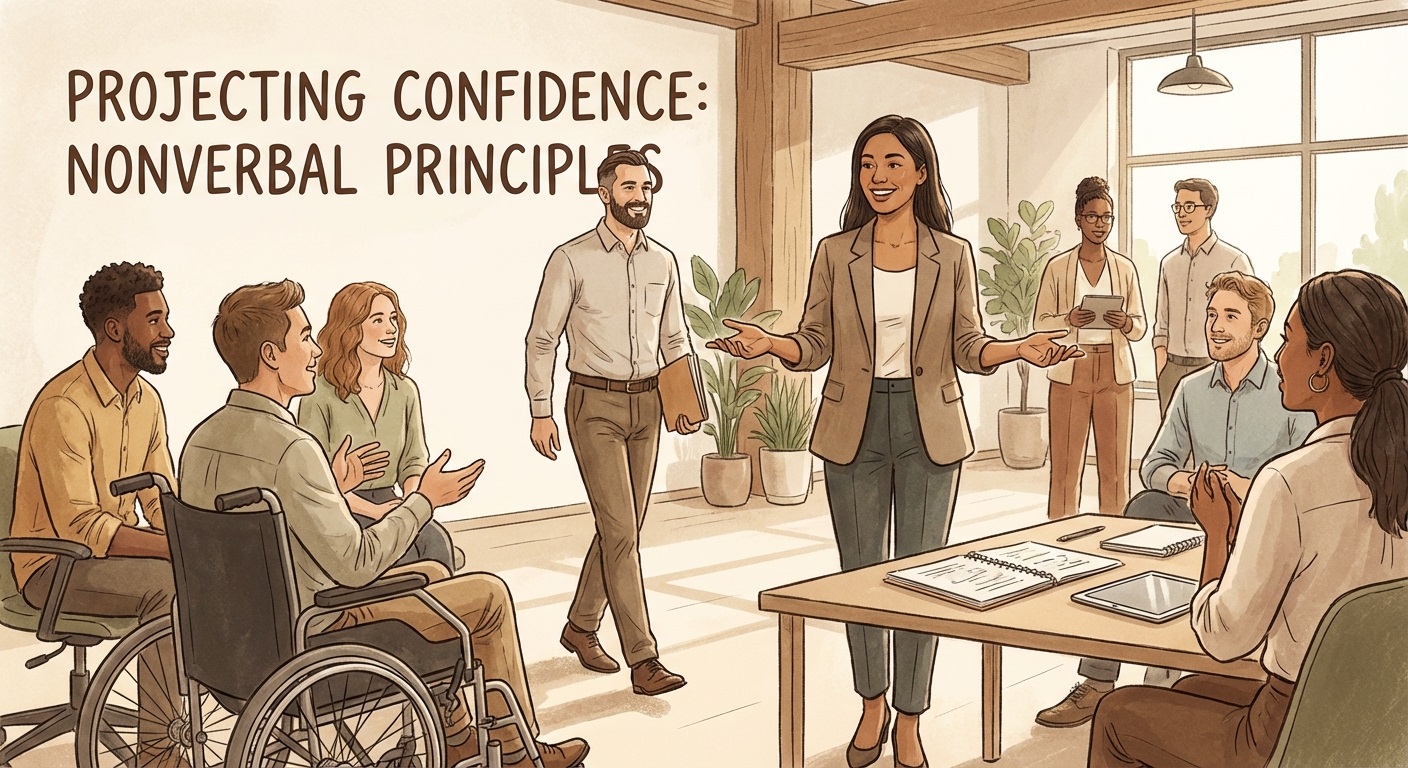
Confidence isn’t something you either have or don’t — it’s a set of behaviors that can be learned, practiced, and projected. Research in social psychology consistently shows that people form impressions within the first seven seconds of meeting someone, and those impressions are driven far more by nonverbal cues than by what you actually say. The good news is that these cues are entirely within your control.
We reviewed peer-reviewed studies in social psychology, behavioral science, and communication research to identify the most effective techniques for projecting confidence. Each trick on this list is backed by documented evidence and can be applied immediately in social, professional, and everyday situations — no months of therapy or self-help programs required.
Quick Overview
| Rank | Trick | Primary Benefit | Difficulty |
|---|---|---|---|
| 1 | Master the pause before speaking | Projects authority and composure | Easy |
| 2 | Hold eye contact for 3–5 seconds | Signals engagement and self-assurance | Easy |
| 3 | Slow your speech by 20% | Conveys calm and credibility | Moderate |
| 4 | Use open body posture | Appears approachable and powerful | Easy |
| 5 | Lower your vocal pitch slightly | Increases perceived competence | Moderate |
| 6 | Take up physical space deliberately | Signals dominance and comfort | Easy |
| 7 | Eliminate filler words | Sounds more decisive and prepared | Hard |
| 8 | Use the person's name in conversation | Creates connection and authority | Easy |
| 9 | Walk 10–15% slower than your instinct | Projects calm and self-possession | Easy |
| 10 | Adopt the "steeple" hand gesture | Signals expertise and certainty | Easy |
| 11 | Arrive early and own the space | Establishes territorial confidence | Easy |
| 12 | Practice strategic vulnerability | Builds trust and authentic authority | Hard |
1. Master the Pause Before Speaking
When someone asks you a question, resist the urge to respond immediately. Instead, pause for one to two seconds before answering. This brief silence does something powerful — it signals that you’re thoughtful, composed, and in control of the conversation. Anxious people rush to fill silence; confident people are comfortable in it. Research published in the Journal of Experimental Social Psychology found that speakers who paused before responding were rated as more credible and authoritative than those who answered instantly.
The pause also gives your brain time to formulate a clearer, more concise response. You’ll find yourself saying “um” and “uh” less often, which further reinforces the impression of confidence. Start practicing in low-stakes conversations — with friends, at coffee shops, during casual meetings — until the pause becomes natural. It feels awkward at first, but to the listener, it reads as poise.
Why it works: Silence signals control; rushing signals anxiety
Where to use it: Job interviews, presentations, negotiations, first meetings
Body language and confidence research on Psychology Today
2. Hold Eye Contact for 3–5 Seconds
Eye contact is one of the most studied nonverbal behaviors in psychology, and the research is clear: people who maintain appropriate eye contact are perceived as more confident, trustworthy, and competent. The sweet spot is 3–5 seconds of direct eye contact before briefly looking away. Less than that reads as evasive or insecure; more than that can feel aggressive or uncomfortable.
A practical technique is the “triangle method” — shift your gaze between the other person’s left eye, right eye, and mouth in a slow triangle pattern. This creates the impression of engaged, natural eye contact without the intensity of a fixed stare. When speaking to a group, hold eye contact with one person per sentence or thought, then move to the next. This makes each person feel acknowledged while projecting confidence to the entire room.
Why it works: Eye contact activates trust circuits in the observer’s brain
Where to use it: Every face-to-face interaction, especially first impressions
Eye contact research on ScienceDirect
3. Slow Your Speech by 20%
Fast talkers are often perceived as nervous, even when they’re not. Slowing your speech rate by roughly 20% — not to a crawl, just noticeably more measured — creates an impression of calm authority. Studies from the University of Michigan found that speakers at a moderate pace (around 3.5 words per second) were rated as more knowledgeable and persuasive than faster speakers.
Slower speech also gives you time to articulate clearly, choose better words, and breathe properly — all of which compound the confidence effect. Record yourself speaking and listen back; most people are surprised by how fast they actually talk. Practice reading aloud at a deliberately slower pace until it feels natural. Pair this with strategic pauses between key points, and you’ll sound like someone who’s worth listening to.
Why it works: Measured speech signals that you believe your words are worth hearing
Where to use it: Presentations, phone calls, meetings, public speaking
Communication and confidence insights on Forbes
4. Use Open Body Posture
Crossed arms, hunched shoulders, and turned-away torsos all signal defensiveness or discomfort. Open body posture — shoulders back, chest slightly forward, arms uncrossed, palms visible — communicates that you’re comfortable, approachable, and unafraid. Social psychologist Amy Cuddy’s research at Harvard, despite debate around the hormonal claims, consistently shows that open postures influence how others perceive you as more confident and capable.
The key is to make open posture your default, not something you consciously switch on. Practice standing and sitting with your shoulders relaxed and back, hands resting naturally at your sides or on a table. Avoid self-soothing gestures like touching your face, crossing your arms, or gripping your own hands — these are subconscious signals of anxiety that observers pick up on instantly, even if they can’t articulate why.
Why it works: Open posture removes physical barriers between you and others, signaling trust
Where to use it: Networking events, interviews, dates, any social setting
Amy Cuddy’s TED Talk on body language
5. Lower Your Vocal Pitch Slightly
Research consistently links lower vocal pitch with perceived competence, authority, and confidence. A study published in the Journal of Voice found that speakers with lower-pitched voices were rated as more dominant and trustworthy across both professional and social contexts. You don’t need to artificially deepen your voice — a slight, natural lowering achieved through proper breathing and relaxation is enough.
The trick is diaphragmatic breathing. When you breathe from your chest, your voice tends to sit higher and thinner. When you breathe from your diaphragm — expanding your belly rather than your chest — your voice naturally drops into a fuller, more resonant register. Before an important conversation or presentation, take three deep diaphragmatic breaths. You’ll notice your voice settles into a lower, calmer tone without any forced effort.
Why it works: Lower pitch is evolutionarily associated with size, strength, and social dominance
Where to use it: Phone calls, presentations, leadership situations, negotiations
Vocal pitch and perception research on PubMed
6. Take Up Physical Space Deliberately
Confident people occupy space without apology. They spread their materials on a conference table, stand with feet shoulder-width apart, and sit without compressing themselves into the smallest possible footprint. This isn’t about being rude or imposing — it’s about not shrinking. Research in nonverbal communication shows that people who take up more space are consistently perceived as more confident and higher-status.
In practice, this means resisting the urge to make yourself small. Don’t tuck your elbows tight against your body. Don’t cross your legs and ankles simultaneously. When standing, plant your feet firmly at shoulder width. When sitting, use the armrests and let your posture expand naturally. When presenting, move around the space rather than anchoring to one spot. These spatial behaviors signal comfort and ownership of your environment.
Why it works: Spatial expansion is a universal dominance signal across cultures and species
Where to use it: Meetings, presentations, social gatherings, interviews
Nonverbal communication insights on Psychology Today
7. Eliminate Filler Words
Every “um,” “uh,” “like,” “you know,” and “basically” chips away at your perceived confidence. Filler words signal uncertainty — they tell the listener that you’re searching for what to say next, which undermines the impression of preparedness and authority. A study from the University of Texas found that speakers who used fewer fillers were rated as more competent, more hirable, and more persuasive.
Eliminating fillers is one of the harder tricks on this list because they’re deeply habitual. The most effective technique is replacement: instead of filling silence with “um,” simply pause. Silence feels longer to you than it does to your listener. Record yourself in conversations or practice sessions and count your fillers — awareness alone reduces them significantly. Toastmasters groups use an “Ah Counter” role specifically for this purpose, and it works remarkably well.
Why it works: Clean speech sounds prepared, decisive, and authoritative
Where to use it: Public speaking, interviews, meetings, podcasts, video calls
Public speaking improvement resources from Toastmasters
8. Use the Person’s Name in Conversation
Dale Carnegie wrote about this nearly a century ago, and modern neuroscience confirms it: hearing your own name activates unique brain regions associated with self-identity and attention. When you use someone’s name naturally in conversation — “That’s a great point, Sarah” or “I see what you
Dale Carnegie wrote about this nearly a century ago, and modern neuroscience confirms it: hearing your own name activates unique brain regions associated with self-identity and attention. When you use someone’s name naturally in conversation — “That’s a great point, Sarah” or “I see what you mean, James” — it creates an immediate sense of connection and signals that you’re fully engaged. It also subtly positions you as the one directing the conversation, which reads as confident.
The key is moderation. Using someone’s name once or twice in a conversation feels warm and attentive. Using it in every sentence feels manipulative or aggressive. Learn names quickly — repeat them when you’re introduced, associate them with a visual detail, and use them within the first minute of conversation to lock them in memory. Forgetting someone’s name signals disinterest; remembering it signals confidence and social intelligence.
Why it works: Name use activates attention and trust circuits in the listener’s brain
Where to use it: Networking, sales, management, any relationship-building scenario
Brain activation and personal name recognition research on PubMed Central
9. Walk 10–15% Slower Than Your Instinct
Pay attention to how confident people move through a room — they’re rarely rushing. A slightly slower walking pace projects calm, self-assurance, and the sense that you’re not anxious about getting somewhere. Research on gait and social perception shows that moderate, purposeful walking speeds are associated with higher status and confidence, while hurried movement signals stress or subordination.
This doesn’t mean shuffling or dawdling. It means walking with purpose but without urgency — steady steps, upright posture, head level rather than looking down. When you enter a room, resist the impulse to dart to the nearest seat. Walk in at a measured pace, make eye contact, and choose your position deliberately. The way you move through physical space communicates volumes about your internal state before you ever open your mouth.
Why it works: Controlled movement signals that you own your time and space
Where to use it: Entering meetings, walking into social events, approaching someone new
Behavioral psychology research from the Association for Psychological Science
10. Adopt the “Steeple” Hand Gesture
The steeple — fingertips of both hands pressed together with palms apart, forming a church-steeple shape — is one of the most powerful confidence gestures in nonverbal communication. Body language experts like Joe Navarro, a former FBI agent, identify it as a high-confidence display used instinctively by people who feel certain about what they’re saying. World leaders, CEOs, and experienced negotiators use it frequently.
The steeple works because it’s the opposite of anxious hand behavior. Nervous people wring their hands, hide them in pockets, or fidget. The steeple is still, deliberate, and exposed — it says “I’m comfortable with what I’m telling you.” Use it when making a point, listening thoughtfully, or pausing during a discussion. Avoid it during moments that call for warmth or empathy, as it can read as detached or superior in the wrong context.
Why it works: Stillness and openness in the hands signal certainty and composure
Where to use it: Meetings, negotiations, interviews, presentations
Joe Navarro’s body language resources
11. Arrive Early and Own the Space
There’s a psychological phenomenon called the “home field advantage” — people feel more confident and perform better in familiar environments. You can manufacture this effect by arriving early to any venue. When you’re the first person in a meeting room, restaurant, or event space, you become the host psychologically. You’ve already oriented yourself, chosen your position, and settled in. Everyone who arrives after you is entering your space.
Use your early arrival strategically. Choose the seat with the best sightlines (typically facing the door). Arrange your materials comfortably. Greet people as they arrive — this simple act positions you as the welcomer rather than the welcomed, which flips the social dynamic in your favor. People who arrive early are also perceived as more organized, more interested, and more respectful of others’ time — all traits associated with confidence.
Why it works: Familiarity with environment reduces anxiety and increases perceived control
Where to use it: Interviews, dates, meetings, networking events, presentations
Leadership and presence research from Harvard Business Review
12. Practice Strategic Vulnerability
This is the most counterintuitive trick on the list, but research from Brené Brown and others consistently shows that selective vulnerability increases perceived confidence rather than diminishing it. When someone admits a mistake, acknowledges uncertainty, or shares a genuine struggle — without excessive apology or self-deprecation — it signals profound self-assurance. It takes more confidence to say “I don’t know the answer to that, but I’ll find out” than to bluff unconvincingly.
The key word is strategic. This isn’t about oversharing personal problems or announcing every insecurity. It’s about being honest in moments where others would deflect or pretend. Admitting you were wrong about something, asking for help when you need it, or acknowledging that a situation is difficult — these acts require genuine confidence and are recognized as such by others. People trust and respect authentic leaders far more than those who project an impossible façade of perfection.
Why it works: Vulnerability requires strength, and observers instinctively recognize that
Where to use it: Leadership roles, relationship building, team management, public speaking
Brené Brown’s TED Talk on vulnerability
How We Built This Guide
Each technique in this guide is supported by published research in social psychology, communication science, or behavioral neuroscience. Key sources include studies published in the Journal of Experimental Social Psychology, Journal of Voice, and Psychological Science. Practical applications draw from established frameworks in nonverbal communication by researchers like Joe Navarro (former FBI behavioral analyst), Amy Cuddy (Harvard social psychologist), and Brené Brown (vulnerability and leadership researcher). Community discussions on r/socialskills and r/confidence informed the practical application tips.
Frequently Asked Questions
Can you fake confidence without feeling it?
Yes, and research supports this. The “act as if” principle — behaving confidently even when you don’t feel it — has been studied extensively. Behavioral feedback loops mean that adopting confident body language, speech patterns, and habits actually begins to shift your internal state over time. You’re not being dishonest; you’re practicing a skill until it becomes natural. Every confident person you admire started somewhere less confident.
How long does it take for these techniques to feel natural?
Most people notice a difference within days of conscious practice, and the techniques begin to feel automatic within 3–6 weeks of consistent application. Start with the easiest ones — open posture, eye contact, and walking pace — and layer in harder skills like eliminating filler words and strategic pausing as the foundational habits solidify.
Won’t people notice I’m using techniques?
No. These techniques work precisely because they mimic naturally confident behavior. No one analyzes why a person seems confident — they just register the impression. The only way these techniques backfire is through exaggeration. Holding eye contact for 30 seconds straight or speaking in an artificially deep voice will seem odd. Subtle, natural application is the key.
Do these work in virtual meetings and video calls?
Most of them adapt well. Eye contact translates to looking at your camera lens (not the screen). Open posture, slower speech, eliminating fillers, and strategic pausing are equally effective on video. Position your camera at eye level, ensure good lighting on your face, and frame yourself from mid-chest up to maximize the visibility of your confident nonverbal cues.
Is there a difference between confidence and arrogance?
Absolutely. Confidence is about comfort with yourself; arrogance is about positioning yourself above others. Confident people listen well, acknowledge others, and don’t need to diminish anyone to feel powerful. Arrogant people interrupt, dismiss, and dominate. Every technique on this list is designed to project confidence without crossing into arrogance — especially the final one on strategic vulnerability, which is the ultimate arrogance antidote.
Final Verdict
Confidence is a skill, not a personality trait. The twelve techniques in this guide are drawn from decades of psychological research and real-world application. You don’t need to master all twelve at once — pick two or three that feel most natural, practice them consistently for a few weeks, and then add more. The compound effect is remarkable. Within a month of deliberate practice, the way people respond to you will begin to shift noticeably. Not because you’ve become a different person, but because you’ve learned to let the confident version of yourself show up more consistently.