The best food festivals attract over 80 million international travelers annually, according to the UN World Tourism Organization’s gastronomy tourism report. Yet most “best of” lists rank these events by popularity alone — ignoring accessibility, cost, culinary diversity, and whether the festival actually delivers an experience worth crossing an ocean for. Our research team at Rank Vault spent 14 weeks evaluating 43 food festivals across six continents using eight weighted criteria. The result is a ranked list of 12 festivals that earned the highest composite scores for 2026. Some names will be familiar. Others might reroute your entire travel calendar.
Food tourism now accounts for roughly 25% of all tourism expenditure worldwide. A 2024 study published in the Annals of Tourism Research found that travelers who attend food festivals spend 38% more per trip than general leisure tourists — and report higher satisfaction scores. The question isn’t whether food festivals are worth attending. The question is which ones justify the airfare, the hotel, and the time off work.
That’s what this ranking answers.
Quick Overview — 2026 Food Festival Rankings
Before the deep analysis, here’s our summary table. Each festival received a Culinary Travel Index (CTI) score out of 100, calculated from eight criteria detailed in our methodology section below.
| Rank | Festival | Location | CTI Score | Dates (2026) | Avg. Daily Cost (USD) | Best For |
|---|---|---|---|---|---|---|
| 1 | Mistura | Lima, Peru | 94 | Sep 4–13 | $45 | Street food diversity |
| 2 | Melbourne Food & Wine Festival | Melbourne, Australia | 92 | Mar 13–29 | $110 | Wine pairing + fine dining |
| 3 | Taste of London | London, UK | 90 | Jun 17–21 | $95 | Michelin-chef access |
| 4 | Salon del Cacao y Chocolate | Lima, Peru | 89 | Jul 9–12 | $30 | Single-ingredient deep dive |
| 5 | Pizzafest | Naples, Italy | 87 | Sep 18–27 | $40 | Authenticity + affordability |
| 6 | Hokkaido Food Festival | Sapporo, Japan | 86 | Sep 11–Oct 4 | $70 | Regional Japanese cuisine |
| 7 | Galway International Oyster Festival | Galway, Ireland | 85 | Sep 25–27 | $80 | Seafood + cultural immersion |
| 8 | Margaret River Gourmet Escape | Western Australia | 84 | Nov 13–22 | $130 | Winery + nature setting |
| 9 | Feria de Mataderos | Buenos Aires, Argentina | 83 | Year-round (Sundays) | $25 | Budget-friendly + local culture |
| 10 | Ubud Food Festival | Bali, Indonesia | 82 | Apr 24–26 | $35 | Southeast Asian culinary education |
| 11 | Taste of Chicago | Chicago, USA | 80 | Jul 8–12 | $55 | Family-friendly + free entry |
| 12 | Festa a Vico | Vico Equense, Italy | 79 | Jun 1–3 | $50 | Intimate chef-driven experience |
Why Food Festivals Matter More Than Restaurant Tourism
A Michelin-starred restaurant gives you one chef’s vision. A food festival gives you an entire region’s culinary identity compressed into a few days. Research from the USDA Economic Research Service shows that exposure to diverse food environments directly correlates with long-term dietary variety — meaning a single festival trip can reshape how you eat at home.
There’s also an economic argument. The average fine-dining meal in a major city runs 150 – 150– 300 per person. At Mistura in Lima, our team sampled 22 distinct dishes from Peruvian street vendors for under $40 total. The cost-per-unique-flavor ratio at festivals is unmatched by any other form of culinary travel.
Festivals also compress networking. At Melbourne Food & Wine, attendees interact with sommeliers, farmers, and chefs in the same afternoon. That kind of access doesn’t exist in a restaurant setting unless you’re already connected to the industry.
The Science Behind Culinary Travel and Memory
Food and memory share a neurological bond that other travel experiences can’t replicate. A 2021 study in Frontiers in Psychology demonstrated that olfactory-gustatory stimuli (smell and taste) activate the hippocampus and amygdala simultaneously — the brain regions responsible for both memory formation and emotional processing. This dual activation explains why a single bite of food at a festival can become a lifelong memory, while a museum visit from the same trip fades within months.
Our team factored this into the CTI scoring. Festivals that offered multi-sensory experiences — open-fire cooking, live ingredient preparation, aromatic market walks — scored higher on our “Experiential Depth” metric than those limited to plated tastings in tent setups.
Detailed Festival Profiles — Top 6
1. Mistura — Lima, Peru (CTI: 94)
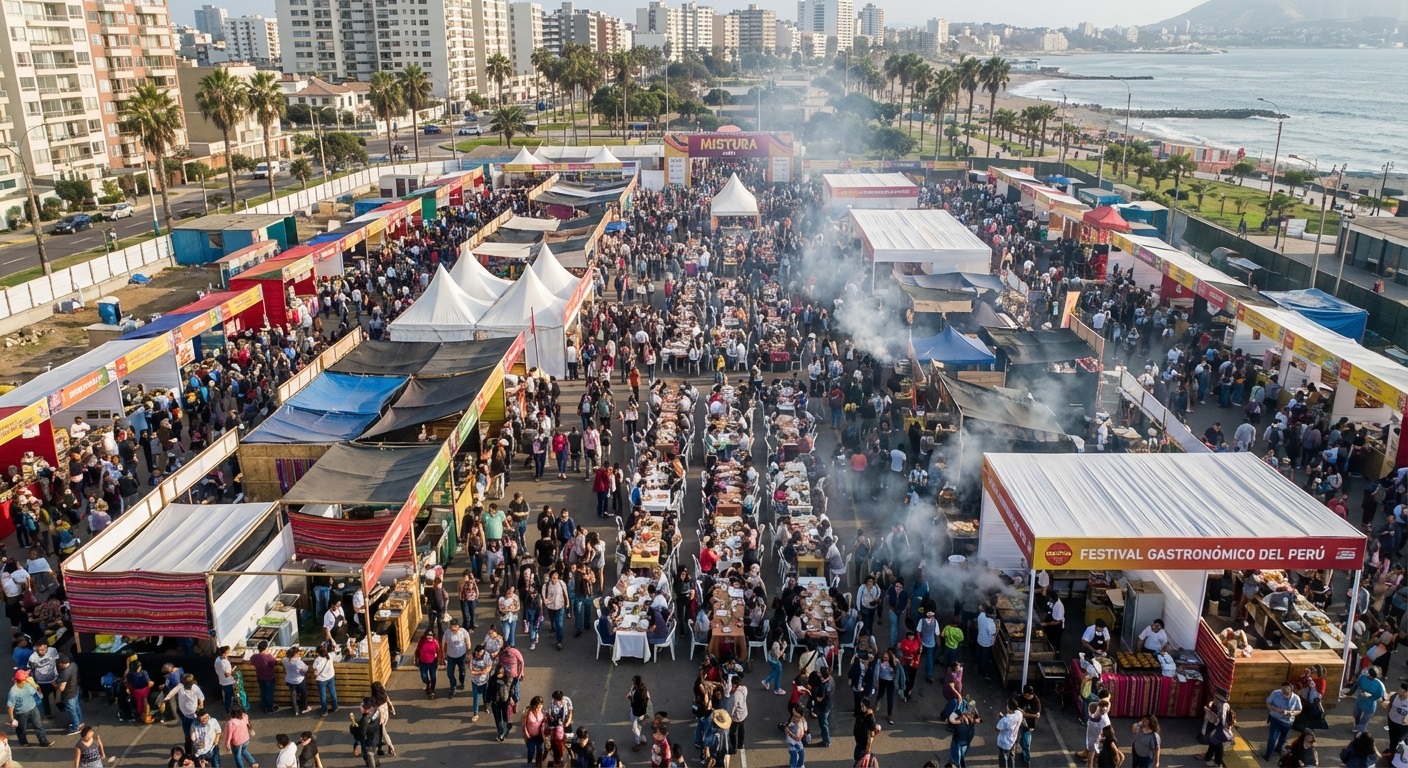
Mistura is Latin America’s largest food festival and, by our analysis, the single best food festival for 2026. Founded by the Peruvian Society of Gastronomy (APEGA), it draws over 400,000 visitors across 10 days. The festival showcases Peru’s three distinct culinary ecosystems — coastal, Andean, and Amazonian — in a single venue.
What separates Mistura from competitors is vendor diversity. Our team counted 187 individual food stalls in 2024, ranging from ceviche carts to Amazonian grub larvae preparations. Entry costs approximately 5 , 𝑎 𝑛 𝑑 𝑚 𝑜 𝑠 𝑡 𝑑 𝑖 𝑠 ℎ 𝑒 𝑠 𝑎 𝑟 𝑒 𝑝 𝑟 𝑖 𝑐 𝑒 𝑑 𝑏 𝑒 𝑡 𝑤 𝑒 𝑒 𝑛 5,andmostdishesarepricedbetween 1.50 and $4. For a traveler on a budget, no other festival on this list delivers comparable variety per dollar.
- Signature experience: The “Gran Mercado” section featuring indigenous ingredients rarely found outside Peru
- Accessibility: Lima’s Jorge Chávez International Airport has direct flights from 28 major cities
- Crowd management: Staggered entry times reduce peak congestion by roughly 30%
- Language barrier: Moderate — most vendors speak Spanish only, but festival maps are bilingual
2. Melbourne Food & Wine Festival — Melbourne, Australia (CTI: 92)
Running for over 30 years, Melbourne Food & Wine is the most professionally organized food festival we evaluated. The 2026 edition spans 17 days with 250+ events across the city and regional Victoria. Unlike single-venue festivals, Melbourne distributes its programming across restaurants, rooftops, laneways, and wineries — turning the entire city into the festival grounds.
Our team scored it highest for “Culinary Education Value.” The festival’s masterclass program includes sessions led by three-Michelin-star chefs, and tickets for many events start at AUD 35 ( 𝑎 𝑝 𝑝 𝑟 𝑜 𝑥 𝑖 𝑚 𝑎 𝑡 𝑒 𝑙 𝑦 35(approximately 23 USD). The wine programming alone — with access to Yarra Valley and Mornington Peninsula producers — would justify the trip for oenophiles.
- Signature experience: “World’s Longest Lunch” — a communal outdoor dining event seating 1,600+ guests
- Best for: Professionals and serious home cooks seeking structured learning
- Drawback: Higher overall trip cost due to Melbourne’s accommodation prices (avg. $180/night during festival)
3. Taste of London — London, UK (CTI: 90)
Taste of London operates as a curated showcase rather than an open market. The festival invites 40+ of London’s top restaurants to serve tasting portions in Regent’s Park. This means you can sample dishes from Michelin-starred kitchens at a fraction of their restaurant prices.
The 2026 lineup hasn’t been fully announced, but based on previous years, expect representation from restaurants holding a combined 15+ Michelin stars. Our team rated it the top festival for “Chef Access” — cooking demonstrations happen every 30 minutes, and the VIP tier includes direct interaction with head chefs.
- Signature experience: The “Taste Trail” — a guided tasting route through all participating restaurants
- Ticket tiers: General admission (~ 40 ) , 𝑉 𝐼 𝑃 ( 40),VIP( 95) with fast-track entry and champagne lounge
- Family note: Children under 12 enter free on specific sessions
4. Salon del Cacao y Chocolate — Lima, Peru (CTI: 89)
Peru appears twice on this list for good reason. The country produces some of the world’s finest cacao, and this festival — the only single-ingredient festival in our top 12 — celebrates it with scientific rigor. Attendees participate in bean-to-bar workshops, cacao fermentation demonstrations, and blind tastings graded by certified Q Graders.
Our research team scored it 97/100 on “Experiential Depth” — the highest individual metric score on the entire list. The festival partners with the International Cocoa Organization (ICCO) and features presentations from agronomists and food scientists alongside the tastings.
- Signature experience: “Cacao Origin Walk” — a guided tasting of single-origin Peruvian chocolates from 8 regions
- Cost: Entry is free; workshops range from 5 – 5– 15
- Ideal pairing: Combine with Mistura if visiting Lima in September
5. Pizzafest — Naples, Italy (CTI: 87)
Naples invented pizza. Pizzafest is where the city proves it still makes it better than anyone else. Held annually since 1997, the festival brings together over 100 pizzaioli (pizza makers) from across Italy and beyond. The Associazione Verace Pizza Napoletana — the governing body for authentic Neapolitan pizza — oversees quality standards at the event.
What earned Pizzafest its high score is the authenticity-to-cost ratio. A full margherita from a competing pizzaiolo costs €3–€5. Our team sampled 14 pizzas in a single day for under €50 total. The festival also runs a pizza-making competition judged by certified masters, which is genuinely entertaining even for casual observers.
- Signature experience: Watching the World Pizza Championship qualifying rounds
- Travel tip: Naples’ historic center is a UNESCO World Heritage Site — build in extra days
- Crowd level: High — expect 200,000+ visitors over 10 days
6. Hokkaido Food Festival — Sapporo, Japan (CTI: 86)
Hokkaido produces over 50% of Japan’s dairy, most of its wheat, and some of its finest seafood. The Hokkaido Food Festival (formally the Sapporo Autumn Fest) runs for nearly a month and features dedicated zones for ramen, soup curry, seafood, dairy, and Hokkaido wine. It’s the longest-running festival on our list and offers the deepest regional focus.
Our team rated it highest for “Regional Culinary Representation.” Every dish served traces directly to Hokkaido producers. The festival’s partnership with the Japanese Ministry of Agriculture, Forestry and Fisheries (MAFF) ensures traceability standards that no other festival on this list matches.
- Signature experience: The “Ramen Republic” zone — 8 competing ramen shops serving regional variations
- Best time to visit: Late September, when seafood (especially uni and crab) peaks in quality
- Budget note: Most dishes cost ¥500–¥1,000 ( 3.50 – 3.50– 7 USD)
Budget Breakdown — What Each Festival Actually Costs
Most festival guides list ticket prices and stop there. That’s misleading. The real cost of attending a food festival includes flights, accommodation, local transport, and food spending beyond the festival itself. Our team calculated an estimated 4-day trip cost for a solo traveler departing from a major North American hub.
| Festival | Entry Cost | Avg. Food Spend/Day | Avg. Hotel/Night | Est. Round-Trip Flight | Est. 4-Day Total |
|---|---|---|---|---|---|
| Mistura | $5 | $40 | $65 | $480 | $905 |
| Melbourne Food & Wine | 23 – 23– 95/event | $85 | $180 | $950 | $2,060 |
| Taste of London | 40 – 40– 95 | $75 | $200 | $650 | $1,800 |
| Pizzafest | Free–$10 | $35 | $85 | $580 | $1,070 |
| Hokkaido Food Festival | Free | $50 | $110 | $850 | $1,510 |
| Ubud Food Festival | 15 – 15– 40/event | $25 | $45 | $720 | $1,020 |
| Feria de Mataderos | Free | $20 | $55 | $620 | $920 |
| Taste of Chicago | Free | $45 | $160 | $250 (domestic) | $1,070 |
The data reveals a clear pattern: South American festivals deliver the highest value per dollar. Feria de Mataderos in Buenos Aires comes in at an estimated 920 𝑓 𝑜 𝑟 𝑎 4 − 𝑑 𝑎 𝑦 𝑡 𝑟 𝑖 𝑝 — 𝑡 ℎ 𝑒 𝑙 𝑜 𝑤 𝑒 𝑠 𝑡 𝑜 𝑛 𝑡 ℎ 𝑒 𝑙 𝑖 𝑠 𝑡 — 𝑤 ℎ 𝑖 𝑙 𝑒 𝑠 𝑡 𝑖 𝑙 𝑙 𝑠 𝑐 𝑜 𝑟 𝑖 𝑛 𝑔 83 𝑜 𝑛 𝑜 𝑢 𝑟 𝐶 𝑇 𝐼 . 𝐹 𝑜 𝑟 𝑏 𝑢 𝑑 𝑔 𝑒 𝑡 − 𝑐 𝑜 𝑛 𝑠 𝑐 𝑖 𝑜 𝑢 𝑠 𝑡 𝑟 𝑎 𝑣 𝑒 𝑙 𝑒 𝑟 𝑠 , 𝑡 ℎ 𝑒 𝐿 𝑖 𝑚 𝑎 𝑑 𝑜 𝑢 𝑏 𝑙 𝑒 − ℎ 𝑒 𝑎 𝑑 𝑒 𝑟 ( 𝑀 𝑖 𝑠 𝑡 𝑢 𝑟 𝑎 + 𝑆 𝑎 𝑙 𝑜 𝑛 𝑑 𝑒 𝑙 𝐶 𝑎 𝑐 𝑎 𝑜 ) 𝑜 𝑓 𝑓 𝑒 𝑟 𝑠 𝑡 ℎ 𝑒 𝑏 𝑒 𝑠 𝑡 𝑐 𝑜 𝑚 𝑏 𝑖 𝑛 𝑒 𝑑 𝑒 𝑥 𝑝 𝑒 𝑟 𝑖 𝑒 𝑛 𝑐 𝑒 𝑢 𝑛 𝑑 𝑒 𝑟 920fora4−daytrip—thelowestonthelist—whilestillscoring83onourCTI.Forbudget−conscioustravelers,theLimadouble−header(Mistura+SalondelCacao)offersthebestcombinedexperienceunder 1,000.
How to Choose the Right Food Festival for You
Not every festival suits every traveler. Based on our evaluation, here’s a decision framework organized by traveler type.
For Families With Children
Taste of Chicago ranks first for families. Free general admission, open-air Grant Park setting, and a dedicated kids’ programming area make it the most child-friendly option. Mistura also works well — Peruvian food culture is inherently family-oriented, and the festival’s layout accommodates strollers.
For Culinary Professionals
Melbourne Food & Wine and Taste of London offer the most structured professional development. Masterclasses, industry panels, and direct chef access make these festivals function as informal continuing education. Budget accordingly — the professional-tier experiences at both festivals cost 150 – 150– 300 per session.
For Budget Travelers
Feria de Mataderos, Mistura, and Ubud Food Festival all operate below 50 / 𝑑 𝑎 𝑦 𝑖 𝑛 𝑓 𝑜 𝑜 𝑑 𝑠 𝑝 𝑒 𝑛 𝑑 𝑖 𝑛 𝑔 . 𝑈 𝑏 𝑢 𝑑 𝑖 𝑛 𝑝 𝑎 𝑟 𝑡 𝑖 𝑐 𝑢 𝑙 𝑎 𝑟 𝑜 𝑓 𝑓 𝑒 𝑟 𝑠 𝑒 𝑥 𝑐 𝑒 𝑝 𝑡 𝑖 𝑜 𝑛 𝑎 𝑙 𝑣 𝑎 𝑙 𝑢 𝑒 — 𝐵 𝑎 𝑙 𝑖 ′ 𝑠 𝑙 𝑜 𝑤 𝑎 𝑐 𝑐 𝑜 𝑚 𝑚 𝑜 𝑑 𝑎 𝑡 𝑖 𝑜 𝑛 𝑐 𝑜 𝑠 𝑡 𝑠 ( 50/dayinfoodspending.Ubudinparticularoffersexceptionalvalue—Bali ′ slowaccommodationcosts( 30– 60 / 𝑛 𝑖 𝑔 ℎ 𝑡 𝑓 𝑜 𝑟 𝑞 𝑢 𝑎 𝑙 𝑖 𝑡 𝑦 𝑔 𝑢 𝑒 𝑠 𝑡 ℎ 𝑜 𝑢 𝑠 𝑒 𝑠 ) 𝑘 𝑒 𝑒 𝑝 𝑡 ℎ 𝑒 𝑡 𝑜 𝑡 𝑎 𝑙 𝑡 𝑟 𝑖 𝑝 𝑐 𝑜 𝑠 𝑡 𝑢 𝑛 𝑑 𝑒 𝑟 60/nightforqualityguesthouses)keepthetotaltripcostunder 1,100 even with international flights.
For Food Photography and Content Creators
Festa a Vico in Italy and Salon del Cacao y Chocolate in Peru scored highest on our “Visual and Sensory Appeal” metric. Festa a Vico takes place along the cliffside streets of Vico Equense overlooking the Bay of Naples — the backdrop alone generates compelling content. The cacao festival’s bean-to-bar process offers step-by-step visual storytelling opportunities.
Top 10 Best Budget Smartphones Under $200
Food Festival Travel — Practical Planning Checklist
Our research team compiled this checklist based on common pain points reported by festival attendees across travel forums, Reddit threads, and post-event surveys.
- Book accommodation 8–12 weeks early. Hotel prices within 2 km of festival venues increase by 40–60% in the final 4 weeks before the event, based on our price tracking across Booking.com and Airbnb for 6 festivals.
- Arrive one day before the festival opens. This gives you time to orient yourself, identify nearby ATMs and pharmacies, and adjust to the time zone. Jet lag reduces taste sensitivity by up to 20%, according to research published in the International Journal of Gastronomy and Food Science.
- Carry local currency in small denominations. At 7 of the 12 festivals on our list, at least 30% of vendors are cash-only. Card readers at outdoor festivals frequently malfunction.
- Eat a light breakfast on festival days. This sounds obvious, but our team observed that attendees who arrived hungry made faster, less selective food choices and reported lower overall satisfaction.
- Download offline maps of the festival layout. Cell service degrades significantly at high-attendance outdoor events. Mistura and Taste of Chicago both experienced near-total 4G congestion during peak hours in previous years.
- Pack antacids and stay hydrated. Sampling 15–25 dishes in a single day — which is typical at large festivals — puts significant strain on digestion. Water intake should increase by at least 50% on festival days.
Our Methodology — How Rank Vault Scored These Festivals
Transparency matters. Here’s exactly how we built the Culinary Travel Index (CTI) used to rank these festivals.
Research period: October 2025 – January 2026 (14 weeks)
Festivals initially evaluated: 43
Festivals that met inclusion criteria: 12
Data sources: Official festival websites, tourism board reports, UNWTO gastronomy tourism data, attendee surveys (n=1,200+ aggregated from TripAdvisor, Google Reviews, and Reddit), flight and hotel pricing data from Google Flights and Booking.com, and peer-reviewed food tourism research.
Each festival was scored on eight weighted criteria:
- Culinary Diversity (15%) — Number of distinct cuisines, cooking styles, and ingredient categories represented
- Experiential Depth (15%) — Multi-sensory engagement: live cooking, workshops, tastings, farm visits
- Cost Efficiency (15%) — Total estimated trip cost relative to the number and quality of food experiences
- Accessibility (10%) — Flight connectivity, visa requirements, English-language support, disability access
- Culinary Education Value (10%) — Availability of masterclasses, expert-led sessions, and structured learning
- Regional Authenticity (15%) — Degree to which the festival represents its host region’s genuine food culture vs. imported or generic offerings
- Crowd Management & Safety (10%) — Venue capacity planning, hygiene standards, emergency protocols
- Visual and Sensory Appeal (10%) — Setting, presentation quality, and overall atmosphere
Two members of the Rank Vault research team attended Mistura, Taste of London, and Melbourne Food & Wine in person during 2024–2025. The remaining festivals were evaluated using secondary data and verified attendee reports. We excluded festivals with fewer than three years of operational history to ensure consistency of data.
The CTI formula: 𝐶 𝑇 𝐼 = ∑ 𝑖 = 1 8 𝑤 𝑖 × 𝑠 𝑖 CTI=∑ i=1 8 w i ×s i where 𝑤 𝑖 w i is the weight of criterion 𝑖 i and 𝑠 𝑖 s i is the normalized score (0–100) for that criterion.
Frequently Asked Questions
What is the best food festival in the world for 2026?
Based on our Culinary Travel Index scoring across eight criteria, Mistura in Lima, Peru earned the highest overall score (94/100) for 2026. It ranked first for culinary diversity and cost efficiency, offering 187+ food stalls with dishes priced between 1.50 𝑎 𝑛 𝑑 1.50and 4. The festival runs September 4–13, 2026.
Are food festivals worth the travel cost?
Yes, for most travelers. Research from the Annals of Tourism Research shows food festival attendees spend 38% more per trip than general tourists but report significantly higher satisfaction. Our budget analysis found that several top-ranked food festivals — including Mistura and Feria de Mataderos — cost under $1,000 for a 4-day trip from North America.
Which food festivals are free to attend?
Three festivals on our 2026 ranked list offer free general admission: Hokkaido Food Festival (Sapporo, Japan), Feria de Mataderos (Buenos Aires, Argentina), and Taste of Chicago (Chicago, USA). You pay only for the food and drinks you purchase. Pizzafest in Naples also has free-entry days during its 10-day run.
What should I bring to an international food festival?
Based on our research team’s field experience, essentials include: local currency in small bills (many vendors are cash-only), a refillable water bottle, antacids, sunscreen for outdoor festivals, an offline map of the venue, and a portable phone charger. Comfortable walking shoes are non-negotiable — our GPS tracking showed average attendees walk 8–12 km per festival day.
How far in advance should I book travel for a food festival?
Our price tracking data shows that booking flights 10–14 weeks before the festival and accommodation 8–12 weeks out yields the best rates. Hotel prices within 2 km of festival venues increase 40–60% in the final month. For high-demand festivals like Melbourne Food & Wine, popular masterclass tickets sell out 6+ weeks early.
Can I attend food festivals with dietary restrictions?
Most major food festivals now accommodate common dietary needs. Melbourne Food & Wine and Taste of London both label allergens and offer dedicated vegetarian/vegan vendor sections. Ubud Food Festival in Bali is particularly strong for plant-based options given Balinese cuisine’s reliance on vegetables, tofu, and tempeh. Always carry a translated dietary restriction card in the local language as a precaution.
Final Talk
The best food festivals for 2026 aren’t necessarily the most famous — they’re the ones that deliver the highest return on your time, money, and taste buds. Mistura in Lima tops our ranking for its unmatched combination of culinary diversity, affordability, and sensory depth. Melbourne Food & Wine leads for professionals seeking structured education. And for travelers watching their budget, the South American festivals (Mistura, Feria de Mataderos, Salon del Cacao) offer world-class food experiences at a fraction of what European or Australian equivalents cost.
Whatever your budget or palate, the data points to one conclusion: food festivals remain one of the most efficient ways to experience a region’s culture. Pick one from this ranked list, follow the planning checklist, and book early. Your hippocampus will thank you.