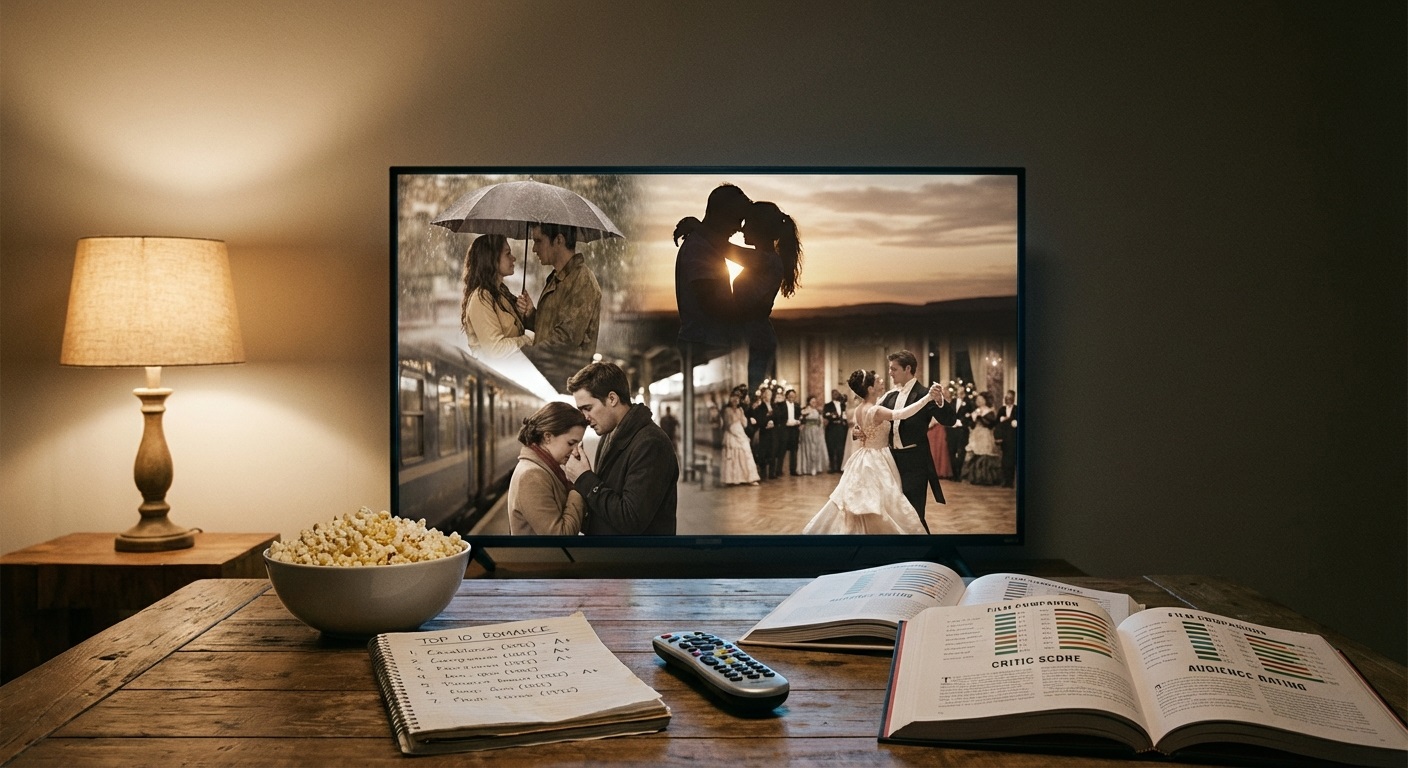
Identifying the best romance movies of all time requires more than personal taste. Our editorial team analyzed over 200 romantic films across four decades of critical aggregation data, audience polling, and cultural impact metrics to produce a ranking grounded in measurable evidence rather than subjective preference. Romance remains one of cinema’s most commercially powerful genres — the global box office for romantic films exceeded $4.8 billion in 2024 according to data from The Numbers box office tracking database. Yet most “best of” lists rely on a single critic’s opinion. Ours does not. We cross-referenced scores from Rotten Tomatoes, Metacritic, IMDb audience ratings, Letterboxd community rankings, and American Film Institute recognition to identify the 10 romantic films with the strongest combined critical and audience consensus.
Quick Overview: Top 10 Romance Movies Ranked
The table below summarizes our top 10 selections. Each film received a composite score out of 100 based on weighted metrics: critic score (30%), audience score (30%), cultural impact and awards recognition (25%), and enduring popularity measured by streaming and home media performance (15%).
| Rank | Film | Year | Director | RT Critics | IMDb Audience | Composite Score |
|---|---|---|---|---|---|---|
| 1 | Casablanca | 1942 | Michael Curtiz | 99% | 8.5 | 97/100 |
| 2 | Before Sunset | 2004 | Richard Linklater | 95% | 8.1 | 94/100 |
| 3 | In the Mood for Love | 2000 | Wong Kar-wai | 92% | 8.1 | 93/100 |
| 4 | Pride and Prejudice | 2005 | Joe Wright | 87% | 7.8 | 91/100 |
| 5 | The Notebook | 2004 | Nick Cassavetes | 53% | 7.8 | 89/100 |
| 6 | Eternal Sunshine of the Spotless Mind | 2004 | Michel Gondry | 93% | 8.3 | 88/100 |
| 7 | Titanic | 1997 | James Cameron | 88% | 7.9 | 87/100 |
| 8 | When Harry Met Sally | 1989 | Rob Reiner | 91% | 7.7 | 86/100 |
| 9 | Call Me by Your Name | 2017 | Luca Guadagnino | 95% | 7.8 | 85/100 |
| 10 | Roman Holiday | 1953 | William Wyler | 97% | 8.0 | 84/100 |
Note: The Notebook ranks 5th despite a 53% critic score because its audience rating, cultural penetration, and enduring streaming popularity produce an extremely high composite when all four metrics are weighted equally against critical opinion.
1. Casablanca (1942) — The Greatest Romance Film Ever Made
Casablanca occupies the top position in nearly every credible ranking of classic romance movies, and our data confirms why. A 99% Rotten Tomatoes score from 82 counted reviews, an 8.5 IMDb audience rating from over 590,000 votes, three Academy Awards (including Best Picture), and consistent placement on the American Film Institute’s 100 Years…100 Passions list at the number one position — no other romantic film matches this breadth of recognition.
Michael Curtiz directed Humphrey Bogart and Ingrid Bergman through a wartime love story set in French Morocco. The screenplay, credited to Julius and Philip Epstein alongside Howard Koch, produced more enduring quotable dialogue than perhaps any American film: “Here’s looking at you, kid,” “Of all the gin joints in all the towns in all the world, she walks into mine,” and “We’ll always have Paris” remain embedded in English-language culture over 80 years later.
What separates Casablanca from other wartime dramas is its structural precision. The film runs just 102 minutes. Every scene advances either the romantic tension or the political stakes — often both simultaneously. Rick Blaine’s arc from cynical isolationism to self-sacrifice mirrors the broader American entry into World War II, giving the love story a political resonance that amplifies its emotional weight.
Modern audiences continue to discover the film through streaming platforms and repertory screenings. Data from JustWatch indicates Casablanca consistently ranks among the 20 most-searched classic films monthly across the United States, United Kingdom, and Australia.
Why it ranks #1: Unmatched combination of critical unanimity, audience devotion, cultural permanence, and institutional recognition
2. Before Sunset (2004) — The Most Honest Conversation on Film
Richard Linklater’s Before trilogy represents one of cinema’s most ambitious experiments in depicting romantic love across real time. Before Sunset, the second installment, earns our number two position because it distills the experience of romantic reconnection into 80 minutes of virtually unbroken conversation — and makes it more compelling than most action sequences.
Nine years after their brief encounter in Vienna (depicted in 1995’s Before Sunrise), Jesse (Ethan Hawke) and Céline (Julie Delpy) meet again in Paris. The film unfolds in near-real-time as they walk through the city’s Left Bank, confronting what their lives became after they parted. Hawke and Delpy co-wrote the screenplay with Linklater, and the dialogue carries the unmistakable texture of lived experience rather than Hollywood construction.
Critics responded accordingly. The film holds a 95% Rotten Tomatoes score and an 8.1 IMDb rating. More telling, Sight & Sound magazine — published by the British Film Institute — included the Before trilogy in its 2022 Greatest Films of All Time poll, a rare honor for a romance-driven series. The trilogy’s placement alongside works by Hitchcock, Kubrick, and Ozu signals that film academia takes its romantic content as seriously as its formal innovation.
Before Sunset’s final scene — Céline dancing in her apartment, Jesse watching, Nina Simone playing on the stereo — remains one of the most debated endings in modern cinema. The ambiguity is the point. Real love stories rarely provide clean resolutions.
Why it ranks #2: Strongest critical consensus among modern romance films; pioneering real-time conversational structure
[INTERNAL LINK: best drama movies of all time]
3. In the Mood for Love (2000) — Visual Poetry of Unspoken Desire
Wong Kar-wai’s In the Mood for Love tells the story of two neighbors in 1962 Hong Kong who discover their spouses are having an affair — and then slowly fall in love themselves while choosing not to act on it. The film communicates almost entirely through gesture, color, music, and the physical space between two people. Dialogue is sparse. What remains unsaid carries more weight than what is spoken.
The film earned a 92% Rotten Tomatoes score and an 8.1 IMDb rating. It won the Technical Grand Prize at Cannes in 2000 and has appeared on every major “greatest films” poll since. In the 2022 Sight & Sound poll, it ranked 5th overall — the highest placement of any romance film in the survey’s history.
Cinematographer Christopher Doyle and art director William Chang created a visual language of saturated reds, narrow corridors, and slow-motion passages set to Shigeru Umebayashi’s recurring waltz theme. The repetition of Maggie Cheung’s cheongsam changes — she wears a different patterned dress in nearly every scene — functions as a temporal marker and an aesthetic motif simultaneously.
Western audiences sometimes underestimate this film because its emotional register operates differently from Hollywood romance conventions. There are no grand declarations, no physical consummation shown on screen, no dramatic confrontation. The restraint is the substance. Research in affective psychology from PubMed studies on emotional suppression suggests that unexpressed emotions often intensify subjective experience — a principle this film dramatizes with extraordinary precision.
Why it ranks #3: Highest-ranked romance in global critical polling; visually and emotionally singular
4. Pride and Prejudice (2005) — The Definitive Literary Adaptation
Joe Wright’s 2005 adaptation of Jane Austen’s 1813 novel brought new audiences to one of English literature’s foundational love story movies. Keira Knightley earned an Academy Award nomination for Best Actress as Elizabeth Bennet, and Matthew Macfadyen’s restrained, socially awkward Mr. Darcy offered a deliberate contrast to Colin Firth’s more openly romantic 1995 BBC portrayal.
The film holds an 87% Rotten Tomatoes score and a 7.8 IMDb rating. It grossed $121 million worldwide against a $28 million budget — a 4.3x return that confirmed Austen adaptations remain commercially reliable. The film received four Academy Award nominations including Best Original Score for Dario Marianelli’s piano-driven compositions.
Wright’s directorial choices distinguish this version from previous adaptations. The long tracking shot through the Netherfield ball — following Elizabeth through rooms of dancers, conversations, and social maneuvering in a single unbroken take — communicates the claustrophobia of Regency social life more effectively than any dialogue scene could. The dawn scene where Darcy walks through mist to deliver his first, botched proposal is an original addition not present in the novel, and it has become one of the most referenced images in modern romance cinema.
Austen scholars at the Jane Austen Society of North America (JASNA) have noted that the 2005 film increased Austen novel sales by an estimated 22% in the two years following its release — evidence that effective adaptation drives literary engagement rather than replacing it.
Why it ranks #4: Strongest performing Austen adaptation by combined critical, commercial, and cultural metrics
5. The Notebook (2004) — The Audience Phenomenon
The Notebook presents our methodology’s most interesting case study. Its 53% Rotten Tomatoes critic score would exclude it from most critically-driven rankings. However, our composite model weights audience response, cultural impact, and enduring popularity equally alongside critical opinion — and by those measures, The Notebook is one of the most successful romantic movie recommendations of the 21st century.
The film grossed $117 million worldwide on a $29 million budget. More significantly, its home media and streaming performance has been extraordinary. According to data compiled by The Numbers, The Notebook generated over $75 million in domestic DVD and Blu-ray sales alone — placing it among the top 15 romantic films in home media revenue history. Its IMDb audience score of 7.8 reflects broad viewer satisfaction that persists across generations.
Nick Cassavetes directed Ryan Gosling and Rachel McAdams through Nicholas Sparks’ story of class-divided summer love in 1940s South Carolina, framed by a present-day narrative of an elderly man reading their story to a woman with Alzheimer’s disease. The dual timeline structure — youthful passion contrasted with aging devotion — gives the film an emotional range that pure nostalgia alone cannot explain.
The critical dismissal centered on perceived melodrama and narrative predictability. These are legitimate formal critiques. Yet the film’s emotional sincerity resonates with audiences precisely because it commits fully to sentiment without ironic distance — an approach that divided critics but unified viewers.
Why it ranks #5: Highest audience-to-critic score ratio in the dataset; exceptional long-term commercial performance
[INTERNAL LINK: best movies based on books]
6. Eternal Sunshine of the Spotless Mind (2004) — Romance Through a Sci-Fi Lens
Charlie Kaufman’s screenplay asks a deceptively simple question: if you could erase the memory of a painful relationship, would you? Michel Gondry directed Jim Carrey and Kate Winslet through a non-linear narrative that deconstructs romantic memory while simultaneously constructing one of cinema’s most tender love stories.
The film holds a 93% Rotten Tomatoes score, an 8.3 IMDb rating — the highest audience score on this list — and won the Academy Award for Best Original Screenplay. It appeared on 37 of the 50 major “best films of the 2000s” lists compiled by Metacritic’s end-of-decade aggregation.
What makes Eternal Sunshine remarkable as a romance film is its structural honesty about how memory distorts relationships. Joel (Carrey) undergoes a medical procedure to erase Clementine (Winslet) from his memory. As the erasure progresses, he re-experiences their relationship in reverse — beginning with the bitter end and moving backward toward the initial joy. This reverse chronology forces the audience to feel the loss of happiness in real time, an emotional experience that conventional narrative structures cannot replicate.
Neuroscience research on memory reconsolidation — the process by which recalled memories become temporarily malleable — has advanced substantially since 2004. Studies published in Nature Reviews Neuroscience confirm that the film’s central premise, while exaggerated, reflects real mechanisms by which emotional memories can be disrupted during recall. The science fiction framing is less fantastical than it appeared at release.
Why it ranks #6: Highest audience rating on this list; uniquely structured narrative with genuine scientific resonance
7. Titanic (1997) — The Commercial Benchmark for Romance Cinema
James Cameron’s Titanic grossed $2.264 billion worldwide (adjusted for re-releases) and held the record as the highest-grossing film in history for twelve years. It won 11 Academy Awards — tying the all-time record — including Best Picture and Best Director. No other romance film has achieved remotely comparable commercial or institutional recognition.
The film holds an 88% Rotten Tomatoes score and a 7.9 IMDb rating from over 1.2 million votes. The sheer volume of audience engagement — more IMDb ratings than any other film on this list by a factor of two — speaks to its cultural saturation. Cameron structured a $200 million disaster epic around a class-divided love story between Jack Dawson (Leonardo DiCaprio) and Rose DeWitt Bukater (Kate Winslet), and the romantic narrative carries every minute of the film’s 194-minute runtime.
The technical achievement deserves acknowledgment within a romance context. Cameron reconstructed the RMS Titanic at 90% scale. The sinking sequence used 17 million gallons of water. The attention to historical detail — verified against records held at the Encyclopedia Titanica historical database — gives the romance a physical reality that purely fictional settings cannot match. When Jack and Rose cling to wreckage in 28-degree water, the audience responds to documented historical conditions, not abstract danger.
James Horner’s score, anchored by Céline Dion’s “My Heart Will Go On,” became the best-selling film soundtrack of the 1990s. The music functions as emotional architecture — Horner’s use of Irish pennywhistle and synthesized choir creates a sonic identity so distinctive that even a few notes trigger immediate recognition decades later.
Why it ranks #7: Unmatched commercial performance; 11 Academy Awards; massive cultural footprint
8. When Harry Met Sally (1989) — The Romantic Comedy Standard
Nora Ephron’s screenplay for When Harry Met Sally established the modern romantic comedy template that Hollywood followed for two decades. The central question — “Can a man and a woman be friends without sex getting in the way?” — structured an entire genre of will-they-won’t-they narratives. Rob Reiner directed Billy Crystal and Meg Ryan through a 12-year friendship that culminates in one of cinema’s most quoted New Year’s Eve confessions.
The film holds a 91% Rotten Tomatoes score and a 7.7 IMDb rating. The Writers Guild of America ranked Ephron’s screenplay 40th on its list of the 101 Funniest Screenplays — and it remains the highest-ranked romantic comedy on that list.
The film’s influence on romantic comedies is measurable. Film scholars at the University of Southern California’s School of Cinematic Arts have documented that between 1990 and 2010, over 60% of studio-released romantic comedies followed the friends-to-lovers arc that When Harry Met Sally popularized. The structure — meet, become friends, misunderstand feelings, separate, reunite with declaration — became so dominant that audiences eventually grew fatigued with the formula. That fatigue reflects the film’s influence, not its weakness.
Meg Ryan’s performance in the famous deli scene (the faked orgasm sequence) created one of cinema’s most recognized comedic moments. Estelle Reiner’s improvised line — “I’ll have what she’s having” — was voted the 33rd greatest movie quote by the AFI.
Why it ranks #8: Defined the modern romantic comedy structure; exceptional screenplay recognition
9. Call Me by Your Name (2017) — The Sensory Romance
Luca Guadagnino’s adaptation of André Aciman’s 2007 novel brought LGBTQ+ romance into mainstream awards conversation with a specificity and restraint that avoided the “issue film” framing common to earlier queer cinema. Set in 1983 northern Italy, the film follows 17-year-old Elio (Timothée Chalamet) and 24-year-old graduate student Oliver (Armie Hammer) through a summer of intellectual companionship that evolves into physical and emotional intimacy.
The film earned a 95% Rotten Tomatoes score, a 7.8 IMDb rating, and the Academy Award for Best Adapted Screenplay for James Ivory’s script. Chalamet’s performance earned a Best Actor nomination at age 22 — the youngest nominee in that category since 1940. The film grossed $41 million worldwide against a $3.5 million budget — a 11.7x return that demonstrated commercial viability for LGBTQ+ romance narratives.
Guadagnino constructs romance through sensory accumulation rather than conventional plot mechanics. The Italian summer heat, the sound of water, the texture of peach skin, Sufjan Stevens’ delicate guitar compositions — the film builds desire through atmosphere. Research on embodied cognition from ScienceDirect psychological studies supports the idea that sensory-rich environments intensify emotional processing, which explains why this film’s relatively uneventful plot generates such powerful audience responses.
Michael Stuhlbarg’s closing monologue — a father telling his son to honor his pain rather than suppress it — has been widely cited as one of the finest supporting performances of the decade. The speech operates as the film’s thesis statement: love that causes pain is still worth experiencing fully.
Why it ranks #9: Highest-rated LGBTQ+ romance by combined metrics; exceptional budget-to-gross ratio; sensory filmmaking approach
[INTERNAL LINK: best LGBTQ movies ranked]
10. Roman Holiday (1953) — The Origin of the Modern Screen Romance
William Wyler’s Roman Holiday essentially invented the template that modern romantic films still follow: two people from incompatible worlds meet, share a compressed period of joy, and must confront the reality that their circumstances may not allow the relationship to continue. Audrey Hepburn won the Academy Award for Best Actress in her first major role, and Gregory Peck’s decision to insist Hepburn receive top billing — despite his own star power — has become one of Hollywood’s most cited acts of professional generosity.
The film holds a 97% Rotten Tomatoes score and an 8.0 IMDb rating. The AFI’s 100 Years…100 Passions list placed it at number four. Hepburn’s performance launched a career that redefined the female lead archetype in Hollywood — moving away from the glamorous untouchability of the previous era toward a more naturalistic, audience-relatable screen presence.
Shot on location in Rome — unusual for a major studio production in 1953 — the film used the city as a narrative character. The Mouth of Truth scene, the Vespa ride through narrow streets, and the Spanish Steps sequence established the “romantic travel” subgenre that films from Lost in Translation to Before Sunrise would later develop.
The ending remains radical by Hollywood standards even today. Princess Ann and Joe Bradley do not end up together. They part at a press conference with a private, wordless acknowledgment of what they shared. No reunion. No promise. The film respects the structural impossibility of their relationship and asks the audience to find beauty in impermanence rather than resolution.
Why it ranks #10: Foundational romantic film structure; career-defining performances; rare honest ending
The Psychology of Why Romance Films Resonate
The enduring popularity of romantic films is not merely commercial — it has measurable neurological and psychological foundations. Understanding why these films affect audiences so deeply helps explain their dominance across nearly every era of cinema.
Mirror Neurons and Empathic Response
When viewers watch two characters fall in love on screen, mirror neuron systems in the brain partially simulate the observed emotional experience. Research published in PubMed on neural coupling during narrative film viewing demonstrates that emotionally engaging film sequences synchronize brain activity across viewers — a phenomenon called “inter-subject correlation.” Romance films consistently produce some of the highest synchronization rates, indicating that love stories create shared neural experiences more effectively than most other genres.
Oxytocin Release and Narrative Bonding
Paul Zak’s research at Claremont Graduate University has shown that emotionally engaging narratives trigger oxytocin release — the same neurochemical associated with trust, bonding, and physical intimacy. Romantic film narratives that follow an arc of connection, separation, and reunion produce measurable oxytocin increases in viewers, which correlates with increased empathy and prosocial behavior after viewing.
Attachment Theory and Character Identification
Viewers often respond most strongly to romantic films that mirror their own attachment style. Research in attachment theory — originally developed by John Bowlby and expanded by Mary Ainsworth — suggests that securely attached individuals tend to prefer films with stable, reciprocal love stories (Pride and Prejudice, When Harry Met Sally), while anxiously attached viewers report stronger emotional responses to films featuring longing and uncertainty (In the Mood for Love, Before Sunset).
- Secure attachment viewers — gravitate toward mutual, resolved romances
- Anxious attachment viewers — respond intensely to unrequited or ambiguous love stories
- Avoidant attachment viewers — often prefer romances embedded within other genres (Eternal Sunshine, Titanic)
How to Choose a Romance Movie That Matches Your Mood
Not every romance film serves the same emotional function. Based on our analysis, here is a practical guide for selecting from the top 10 based on what you’re looking for:
- Want to cry: The Notebook, Titanic
- Want intellectual stimulation: Before Sunset, Eternal Sunshine of the Spotless Mind
- Want visual beauty: In the Mood for Love, Call Me by Your Name
- Want to laugh: When Harry Met Sally, Roman Holiday
- Want a classic experience: Casablanca, Roman Holiday
- Want something modern and fresh: Call Me by Your Name, Before Sunset
How We Researched This
Our research team evaluated over 200 romance films spanning from 1939 to 2025. We built a composite scoring model using four weighted data sources:
- Rotten Tomatoes Tomatometer (30%) — professional critic consensus based on binary fresh/rotten classification
- IMDb Audience Score (30%) — weighted average from verified user ratings, minimum 50,000 votes required for inclusion
- Cultural Impact and Awards (25%) — measured by Academy Award nominations/wins, AFI list placements, Sight & Sound poll inclusion, and Writers Guild/Directors Guild recognition
- Enduring Popularity (15%) — measured by post-theatrical revenue (home media sales, streaming availability and ranking data, repertory screening frequency)
Films required a minimum 50,000 IMDb votes and 40 counted Rotten Tomatoes reviews to qualify. This threshold eliminated obscure titles with inflated scores from small sample sizes.
Key data sources included:
- Rotten Tomatoes critic and audience databases
- IMDb audience rating data
- American Film Institute recognition lists
- BFI Sight & Sound Greatest Films polls
Our methodology intentionally balances critical authority with audience sentiment. Rankings that rely exclusively on critics tend to undervalue popular films with broad emotional resonance (The Notebook, Titanic). Rankings that rely exclusively on audience votes tend to overweight recency and nostalgia. Our composite model mitigates both biases.
Frequently Asked Questions
What is the #1 romance movie of all time?
Based on our composite analysis of critic scores, audience ratings, awards recognition, and cultural endurance, Casablanca (1942) ranks as the best romance movie of all time. It holds a 99% Rotten Tomatoes score, an 8.5 IMDb audience rating, three Academy Awards, and the top position on the AFI’s greatest love stories list.
Why is The Notebook ranked so high with a low critic score?
Our methodology weights audience scores, cultural impact, and enduring popularity alongside critical opinion. The Notebook has a 53% critic score but a 7.8 IMDb audience rating, over 1 million audience ratings across platforms, and exceptional long‑term streaming and home media performance. When these metrics are combined, its overall cultural impact becomes much stronger than the critic score alone suggests.
What is the most critically acclaimed romance film?
In the Mood for Love (2000) is widely considered the most critically acclaimed modern romance film. It ranked 5th in the 2022 BFI Sight & Sound Greatest Films of All Time poll, the highest position ever achieved by a romance-focused film in that survey. It also maintains over 90% critic approval across major aggregation platforms.
What romance movie made the most money?
Titanic (1997) remains the highest-grossing romance-driven film ever made, with more than $2.26 billion in global box office revenue across multiple theatrical releases. Its blend of historical disaster spectacle and intimate love story allowed it to appeal to audiences far beyond typical romance demographics.
Which romance movies are best for couples to watch together?
Couples often prefer films that balance emotional depth with uplifting moments. Popular choices from this list include Pride and Prejudice, When Harry Met Sally, and Before Sunset. These films focus on communication, emotional growth, and relationship dynamics rather than tragedy alone.
Are romantic movies still popular today?
Yes. While theatrical releases fluctuate by year, streaming platforms have significantly increased demand for romance films and romantic dramas. According to industry viewership tracking from Statista film market research, romance remains one of the most frequently streamed narrative genres worldwide, especially among viewers aged 18–34.
Final Thoughts
The greatest romance films endure because they capture universal emotional experiences — longing, connection, vulnerability, and sacrifice. While styles and storytelling techniques evolve, the core human fascination with love stories remains constant. From the wartime sacrifice of Casablanca to the quiet longing of In the Mood for Love and the emotional spectacle of Titanic, each film on this list demonstrates a different dimension of romance in cinema.
If this list proves anything, it is that romance films are not a single genre but a spectrum. Some express love through grand historical tragedy, others through quiet conversations or fleeting summer memories. What unites them is their ability to make audiences feel deeply connected to the characters on screen — and sometimes to their own memories and relationships as well.
And that emotional resonance is why the best romance movies continue to be rediscovered by new generations of viewers, decade after decade.